Many visitors to Gion Matsuri believe that the float procession on July 17th is the festival itself. In fact, it is just one of more than thirty events spread across thirty-one days.
The events most deeply connected to Japan’s traditional performing arts are concentrated in the first half of July, before the main processions. This guide is written for those who want to experience Gion Matsuri at a greater depth.
What Gion Festival Actually Is
Gion Festival is the annual festival of Yasaka Shrine in Kyoto’s Gion district. It has been held every July since 869 AD, when the city performed a ritual purification to pray for the end of a devastating plague. That original purpose — communal prayer for protection from disease and disaster — has never changed.
The festival runs for the entire month of July, with more than thirty events of varying scale. The float processions and mikoshi processions are the most famous, but many of the most compelling events take place in the first half of July.
The Sacred Core: Processions and Prayers
To understand Gion Festival, it helps to understand what the festival is actually for. Everything — the floats, the sacred children, the musicians, the weeks of preparation — exists in service of two processions of mikoshi (portable shrines) that carry the deities of Yasaka Shrine through the streets of Kyoto.
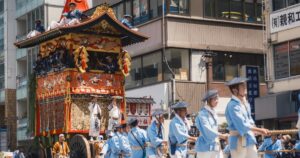
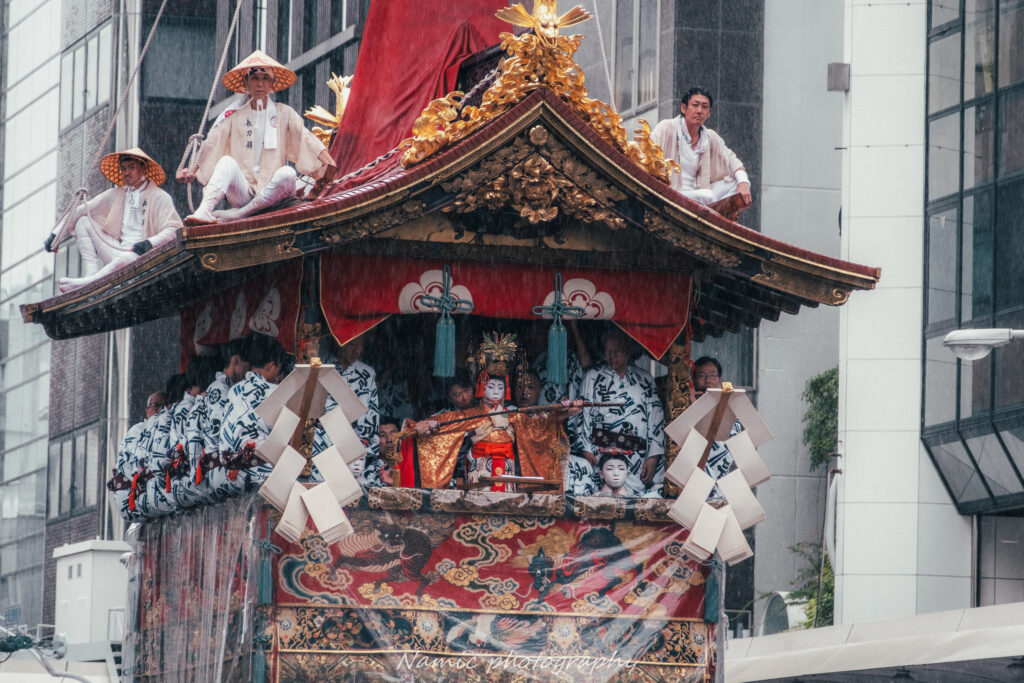
The Yamahoko Junko (July 17 and 24) — the grand float processions — are the purification of the city’s streets in advance of the deities’ passage. Twenty-three floats process on July 17th; eleven on July 24th. The most dramatic moment is the tsuji-mawashi: the corner turns, where the enormous wheeled floats are pivoted ninety degrees by teams of men using bamboo poles, with no mechanical assistance.
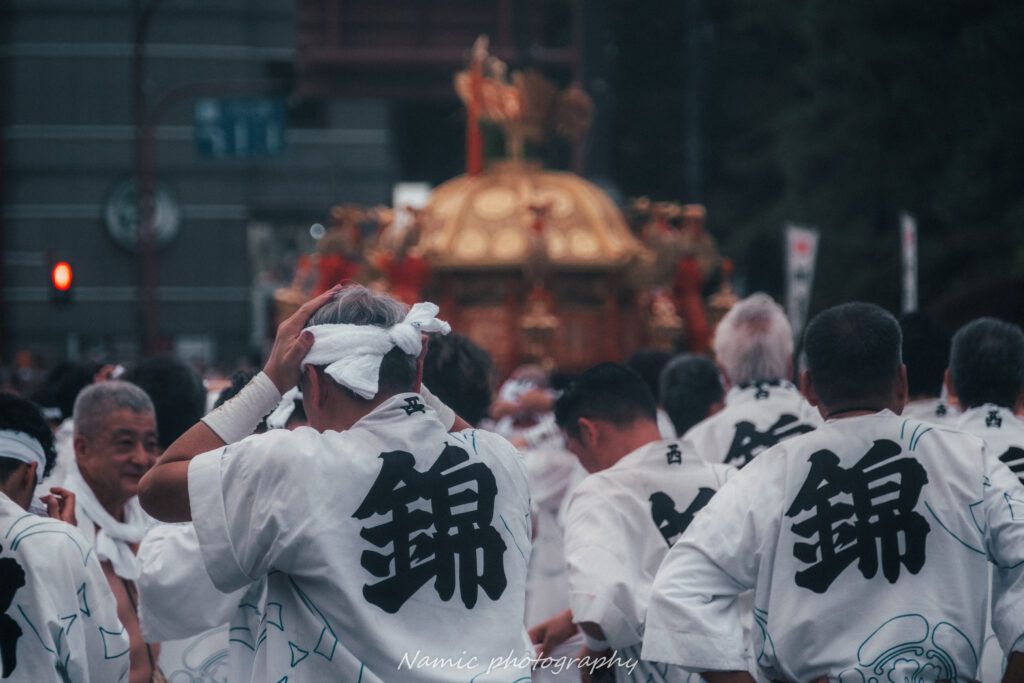
The Shinkosai (July 17, evening) is the procession in which the three sacred mikoshi depart Yasaka Shrine and are carried through the city to the Otabi-jinja sub-shrine, where the deities will rest for the week between the two processions. This is, in the theological framework of the festival, the central event of the entire month. The bearers run and lunge through the streets chanting, the energy entirely different from the ordered spectacle of the float procession earlier in the day.
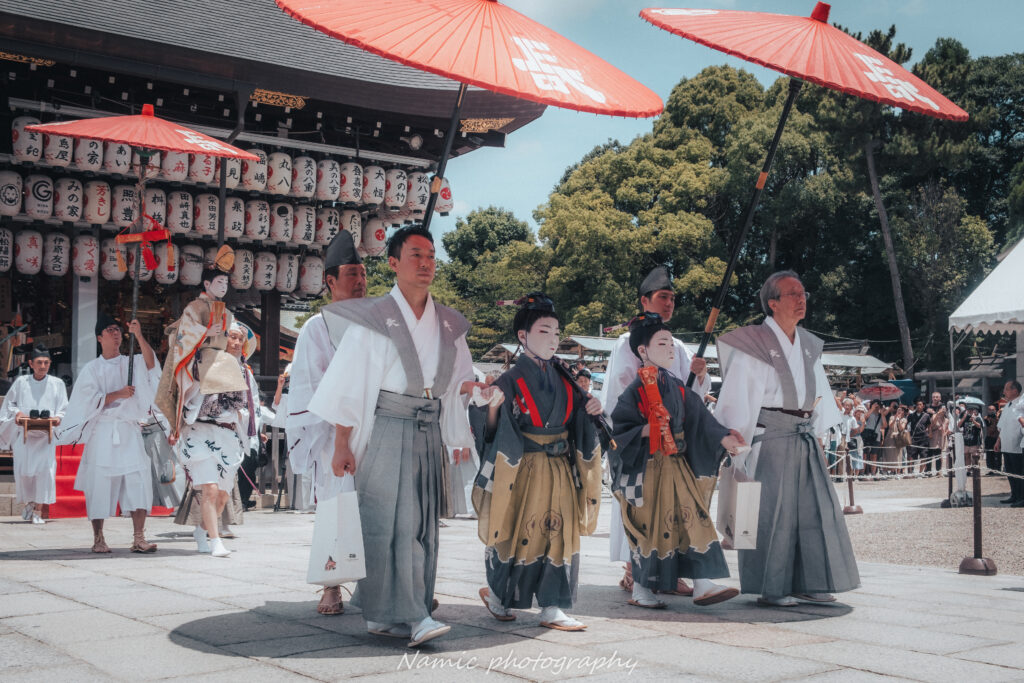
The Hanagasa Junko (July 24, morning) takes place on the same day as the Ato Matsuri float procession, and offers something entirely different in character. Where the Yamahoko Junko is solemn and architecturally grand, the Hanagasa Junko is a procession steeped in performing arts. Around 1,000 participants parade through the city — flower-umbrella floats, children’s mikoshi, horseback riders, lion dancers, and the Gion Taiko drummers — with geiko and maiko from two of Kyoto’s hanamachi (rotating each year) riding on decorated floats. The procession originated in 1966 as a complement to the Ato Matsuri, reviving the ancient form of the festival’s original umbrella floats. After the procession returns to Yasaka Shrine, dance and performance are dedicated on the shrine’s stage: the participating hanamachi each offer their own traditional dance, including Kabuki-odori, Komachi-odori, Suzume-odori, and Konchiki Ondo depending on the year.
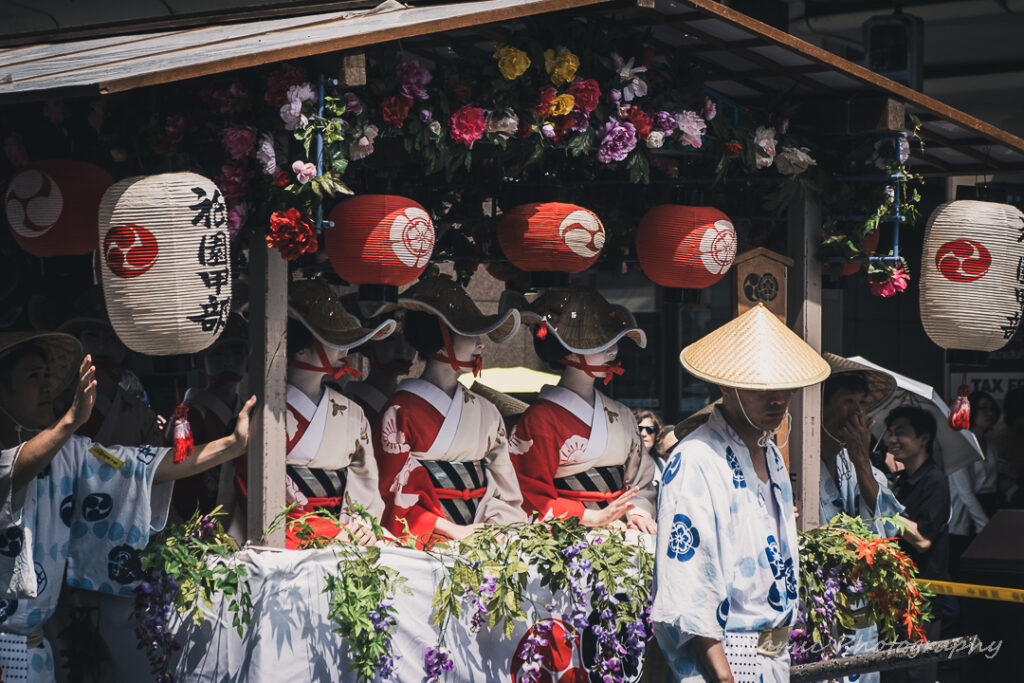
The Kanko Sai (July 24, evening) is the return: the three mikoshi are carried back to Yasaka Shrine, arriving after dark. The final moments, when the lights of the shrine compound are extinguished and the deities are transferred back into the main hall in darkness, mark the close of the festival’s sacred core.
Without the Yamahoko Junko, the Shinkosai, and the Kanko Sai, the floats, the music, and the sacred dance are preparation and context — nothing more. Gion Matsuri is, at its heart, a city coming together in prayer. That essence has not changed in 1,150 years.
The Performing Arts Woven into the Festival
July 5 — The Sacred Dance of the Ochigo
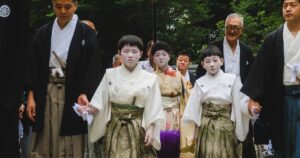
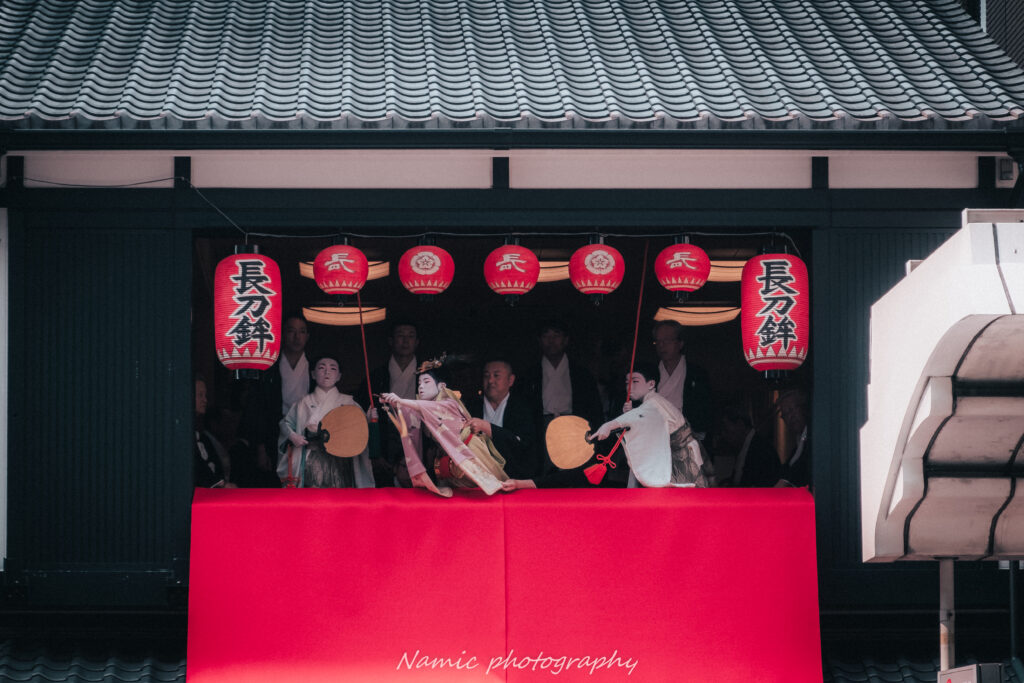
On July 5th, at around 3:30pm, the ochigo — the sacred child at the centre of the Naginata Hoko float — performs the Taihei no Mai (Dance of Great Peace) from the second floor of the float’s assembly hall on Shijo-dori.
The Taihei no Mai is a formal ritual dance performed to pray for peace and freedom from illness. Its movements — slow, deliberate, centred on the precise positioning of the fan and feet — share the same aesthetic principles as Noh’s shimai: the solo dance sequences performed without costume or mask that form the backbone of Noh training and performance.
This is not a tourist demonstration. It is a religious ceremony performed by a child who has been preparing for this role for months. The connection to Noh is not one of direct lineage, but of shared aesthetic heritage: both the Taihei no Mai and Noh shimai draw on the same classical tradition of Japanese formal movement.
July 10 — The Heron Dance and the Welcoming Lantern Ceremony
The evening of July 10th is one of the most overlooked events in the Gion Matsuri calendar.
The Omukae Chochin (Welcoming Lantern Ceremony) is a procession that sets out to welcome the sacred mikoshi ahead of its purification ritual later that night. Departing Yasaka Shrine at 4:30pm, the procession heads west along Shijo-dori, then north along Kawaramachi-dori to Kyoto City Hall, where dances are performed. It then returns south along Teramachi-dori, passes the Otabisho sub-shrine on Shijo-dori, and proceeds to Maruyama Park, arriving around 7:30pm.
Within this ceremony, the Sagamai (Heron Dance) is performed: dancers in white heron costumes move through a formal sequence of movements as part of the ritual greeting to the arriving deities.
The Sagamai is an ancient ritual dance with roots in the Gion Festival itself. It is not derived from Noh or Kyogen — it belongs to a separate tradition of shrine performance. What makes it worth attending is precisely this: it is a form of ritual performance that exists nowhere else, in a context that is entirely religious rather than theatrical.
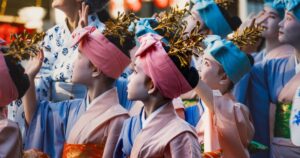
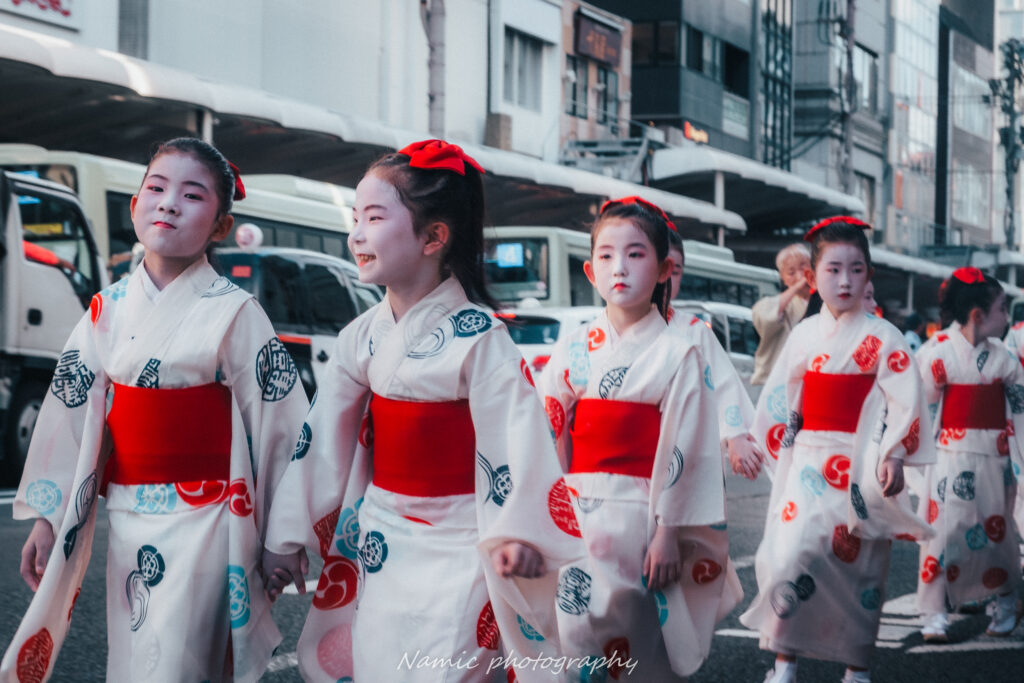
The procession is largely led by children — child warriors (komusha), girls performing the Komachi dance, young participants carrying lanterns — making it one of the more intimate and unhurried events in the festival calendar.
July 16 and 23 — The Night Procession of Musicians
The Hiyori Kagura is, for anyone interested in traditional Japanese music, the most significant event in the festival calendar that most visitors never attend.
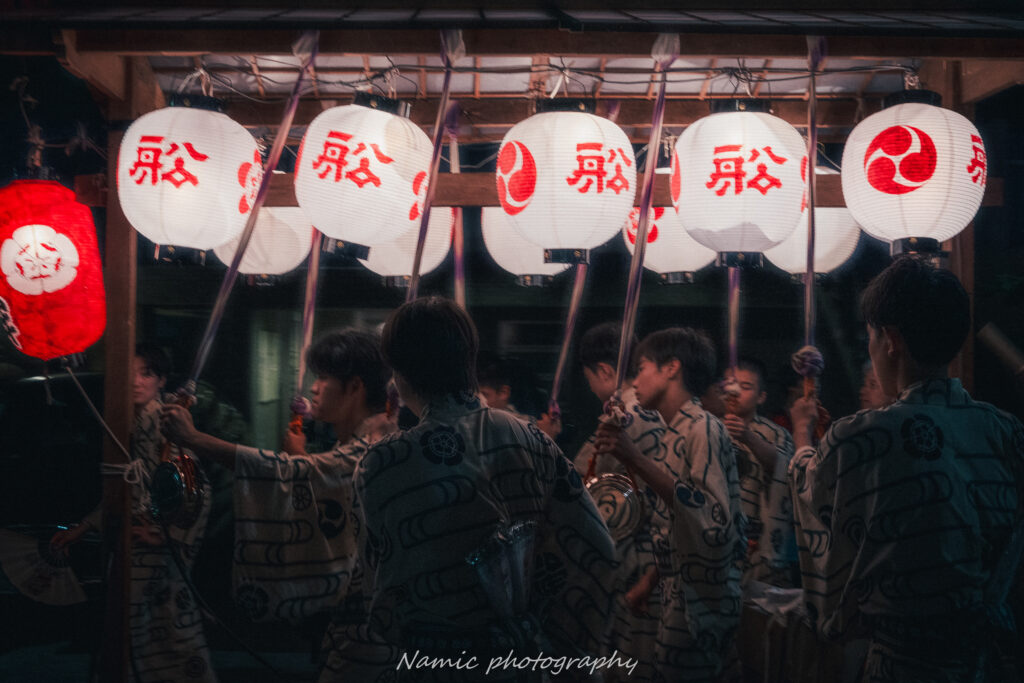
Beginning around 9pm on July 16th (and 8:30pm on July 23rd for the Ato Matsuri), each float’s hayashi ensemble loads their instruments onto a wheeled platform and processes through the streets to pray for clear weather for the following day’s procession.
The Gion bayashi — the music of Gion Festival — has been designated an Intangible Cultural Heritage by UNESCO. The ensemble comprises flute (fue), gong (kane), and drums (taiko): the same instrumental combination used in Noh theatre’s musical accompaniment. Hearing this music live in the streets, moving through Kyoto’s festival neighbourhood at night, is an experience that no indoor setting can replicate.
The music is repetitive by design. It is meant to be sustained, hypnotic, and ceremonial — qualities it shares with the musical structure of Noh.
Among the floats that participate in Hiyori Kagura, the Ayakasa Hoko group performs the bofuri hayashi — a style of festival performance unique to this float, in which performers spin decorated poles while playing — at three points along the way, crossing the Kamo River into Gion and returning past midnight.
From the Festival to the Stage
Gion Matsuri offers something rare: a chance to encounter Japan’s performing arts traditions not on a stage, but woven into the fabric of a living religious ceremony. The sacred dance on July 5th, the ritual music moving through the streets on July 16th — these are not performances staged for audiences. They are practices that have been continuous for over a thousand years.
For visitors who want to take this encounter further, Kyoto offers the opportunity to experience Noh and Kyogen directly — not as observers, but as participants.
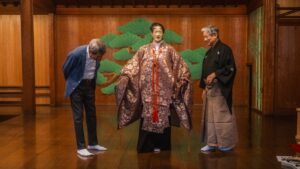
At BASE KYOTO, we offer private Noh and Kyogen experiences led by active masters. Noh experiences take place at an exclusive Noh theatre; Kyogen can be experienced at the theatre, in a traditional machiya townhouse, or at a venue of your choosing. You will handle authentic Noh masks, learn the foundational posture and movement principles, and walk the hashigakari — the bridge that connects the green room to the stage. For Kyogen, you will learn and perform a short exchange under the guidance of a working practitioner.
These experiences are entirely private, conducted in English, and designed for visitors who want genuine depth rather than a staged demonstration.
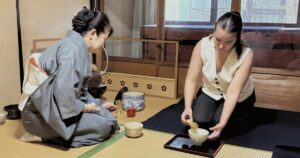
BASE KYOTO offers private cultural experiences in Kyoto — Noh, Kyogen, tea ceremony, wagashi making, zazen, and more — led by certified masters, conducted in English, and tailored entirely to your group.