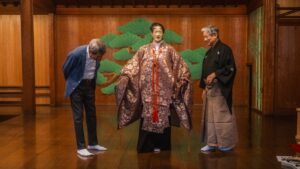
We hosted a private noh experience for a married couple from Mexico at a noh theatre in Kyoto, reserved exclusively for the two of them. Both guests work as actors and have a strong interest in Japanese culture. One of them had previously taken workshops with Richard Emmert, the American scholar and performer who has spent decades teaching noh to practitioners outside Japan, so the couple arrived with prior knowledge of the form. This report covers that private noh experience, held in July.
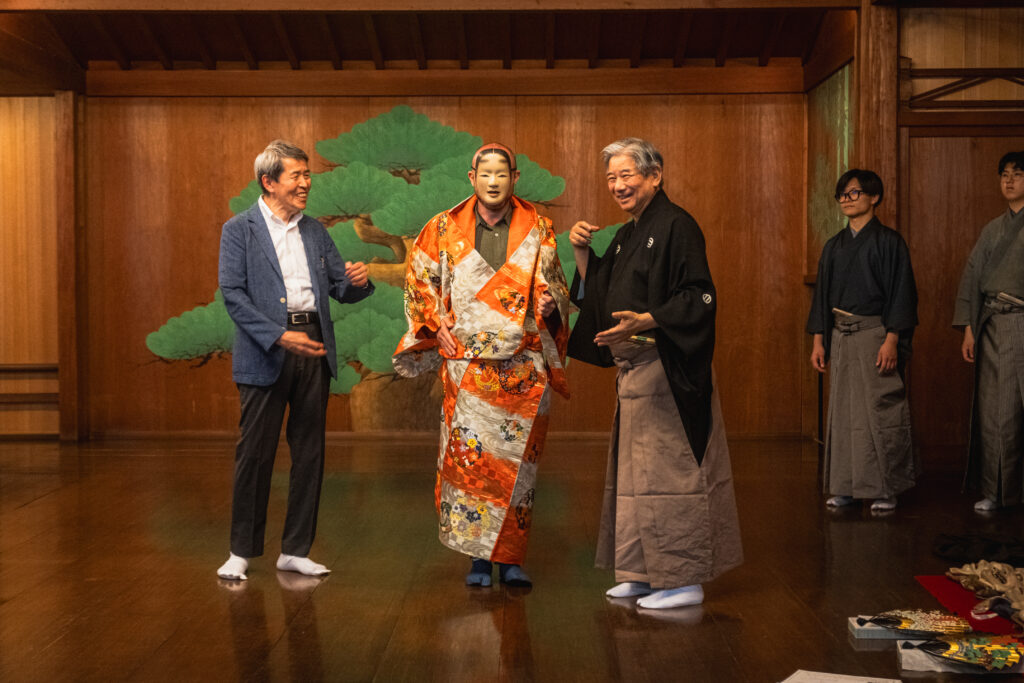
Overview
The instructor was a noh performer holding national certification in the skills of nohgaku, which is designated an Important Intangible Cultural Property of Japan. The session ran for about 90 minutes. The program moved through a talk on noh, a walking session on stage in mask and full costume, a private performance, and a Q&A with photographs. Dialogue ran through all of it — the guests listened, then stepped onto the stage and worked through the performer’s movements themselves, and finally watched a performance staged for the two of them alone. It made for a dense session.
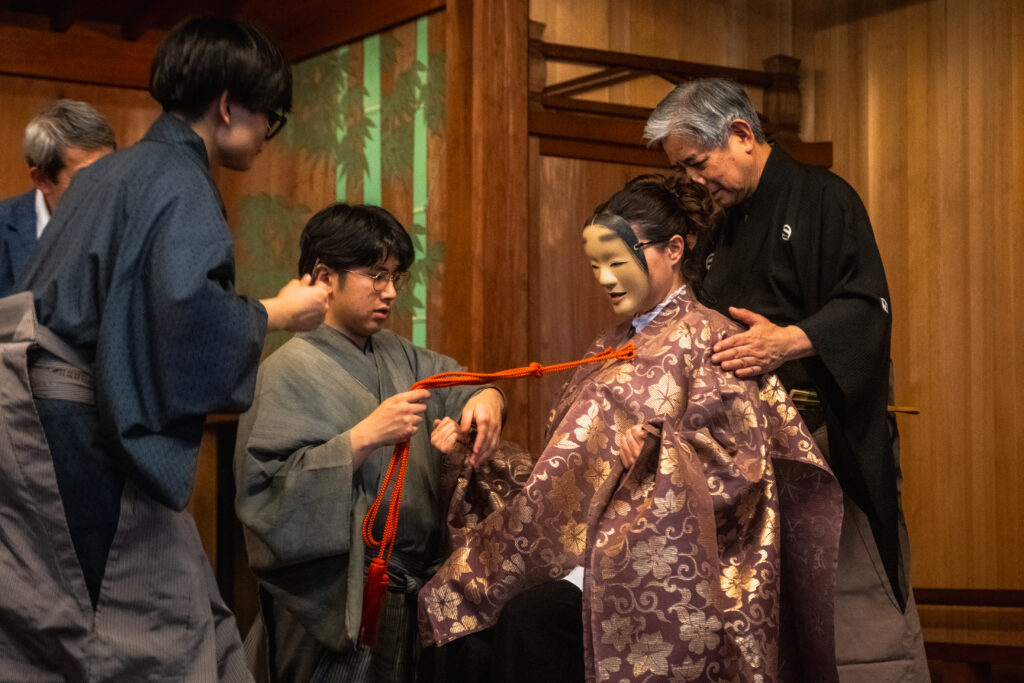
Most encounters with noh end at the audience seat: you watch a play from the house and leave. Reserving the theatre itself and building the guests’ own time on stage into the program puts this experience in a different category altogether.
Before the session, the guest wrote to us with a specific request:
As both my wife and I are theatre practitioners, we would be deeply interested in learning not only about the physical techniques, kata, movement, and stage practice of Noh, but also about the artistic and philosophical principles that give those forms their depth, beauty, and sense of yūgen.
The program was built around that. Rather than stopping at demonstration and hands-on practice, we allocated time to the reasoning behind the forms — why noh is constructed the way it is. The generous Q&A at the end came from the same request.
What the Program Covered
A Talk by the Noh Performer
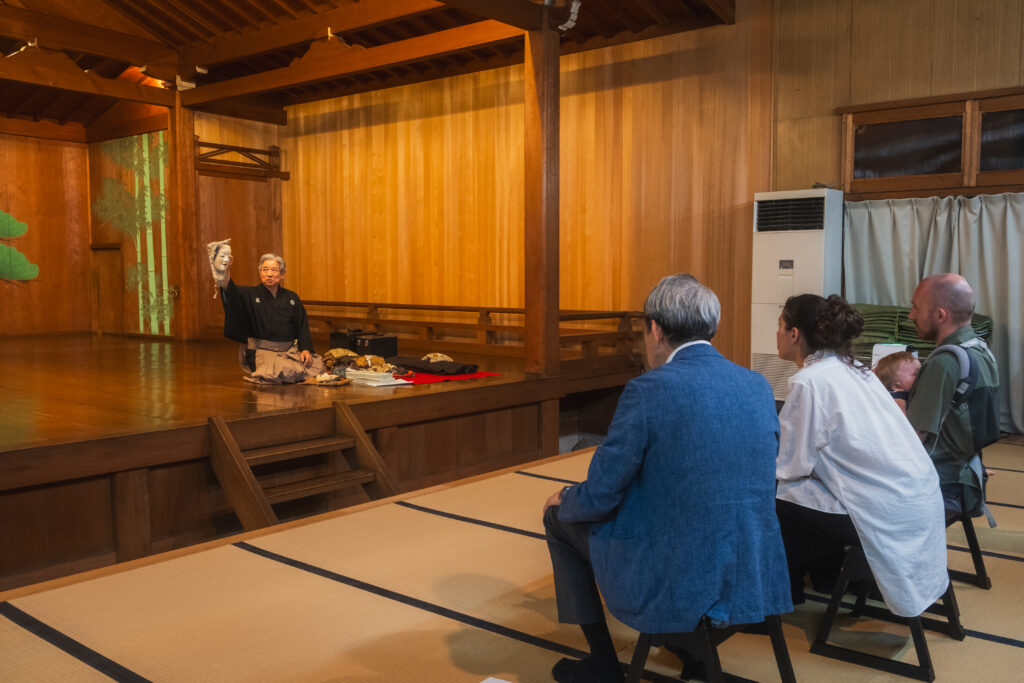
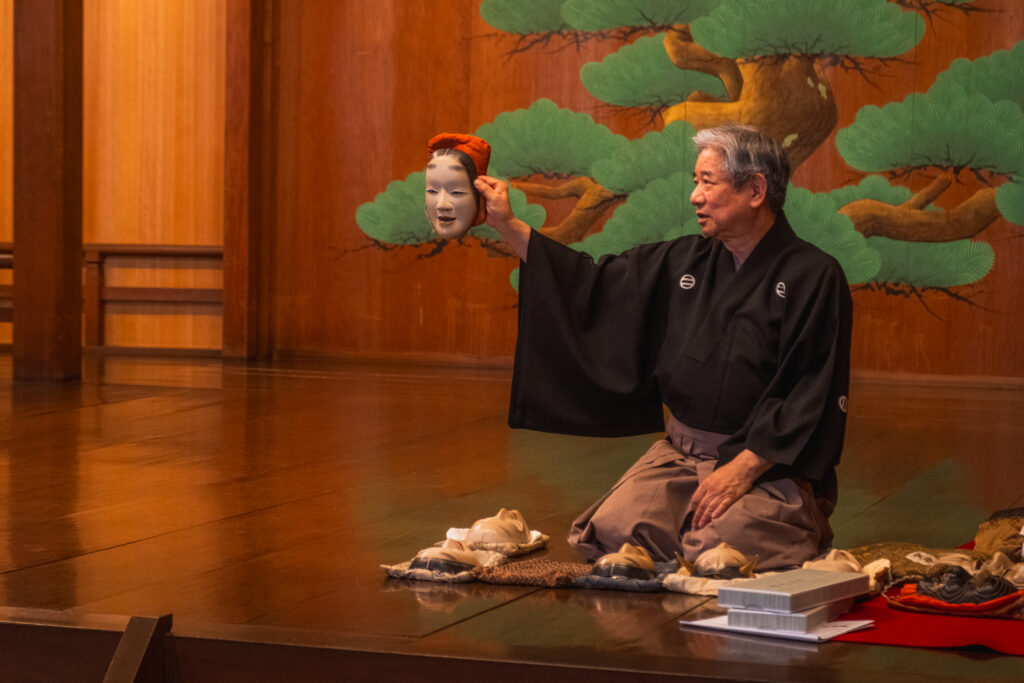
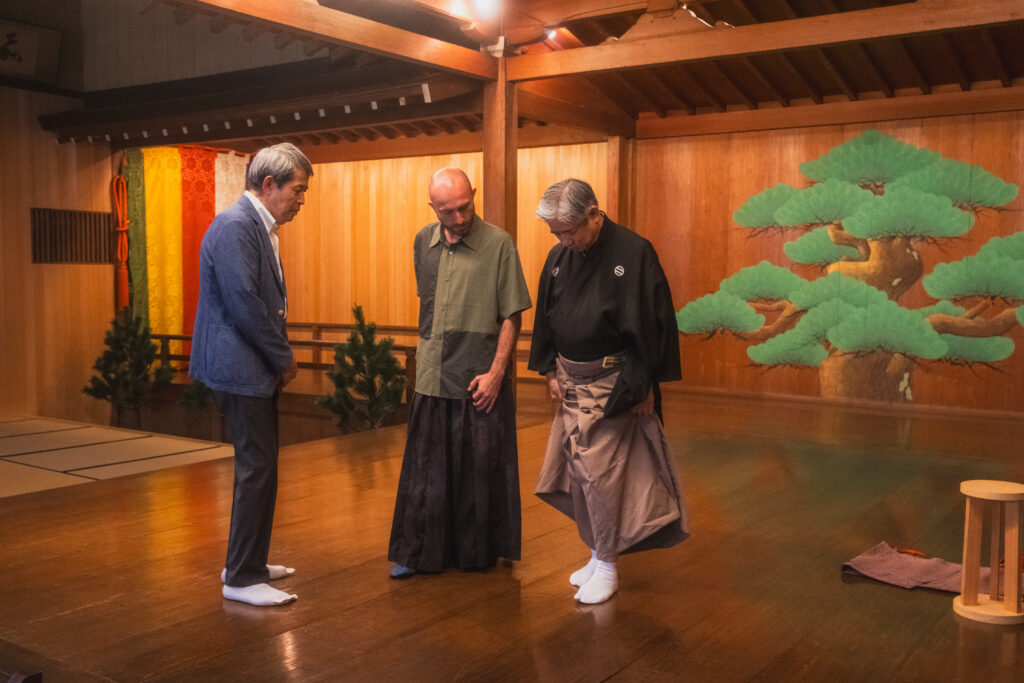
Before any costume came out, the instructor walked the guests through the structure of the noh stage. Every part of a noh stage follows a fixed form, and each one exists for a reason.
- A roof over the stage, even in an indoor theatre — noh was originally performed outdoors in shrine and temple precincts, and modern theatres, though fully enclosed by a building, keep the roof
- The metsuke-bashira — the pillar at the front right of the stage. A masked performer’s field of vision narrows severely, so this pillar serves as the reference point for locating himself and the edge of the stage
- The hashigakari — the passage running to the stage from the rear left. It is not simply an entrance; it is treated as a passage connecting this world and the other, and important parts of a play sometimes unfold on it
- Three pine trees along the hashigakari — decreasing in size away from the stage, which makes the passage read as longer than it is
- The kagami-ita — the panel at the back of the stage, which usually carries a painting of an aged pine. One account holds that it mirrors the yogo no matsu, a sacred pine at Kasuga Shrine in Nara. Yogo refers to the descent of a deity into this world, marking the noh stage as a sacred space where the performer performs toward the god. Another view is that the motif took hold because pine, being evergreen, does not change with the season
- The floor — the boards are primarily hinoki (Japanese cypress), laid to a specific design that carries the sound of a performance. This theatre has large ceramic jars set beneath the stage. They are said to affect not only the sound of the stamping but the chant and the instruments as well
The talk ran as a dialogue rather than a one-way explanation, with the guests asking questions throughout. Because both are actors, their questions centered on stage practice.
Walking the Stage in Mask and Costume
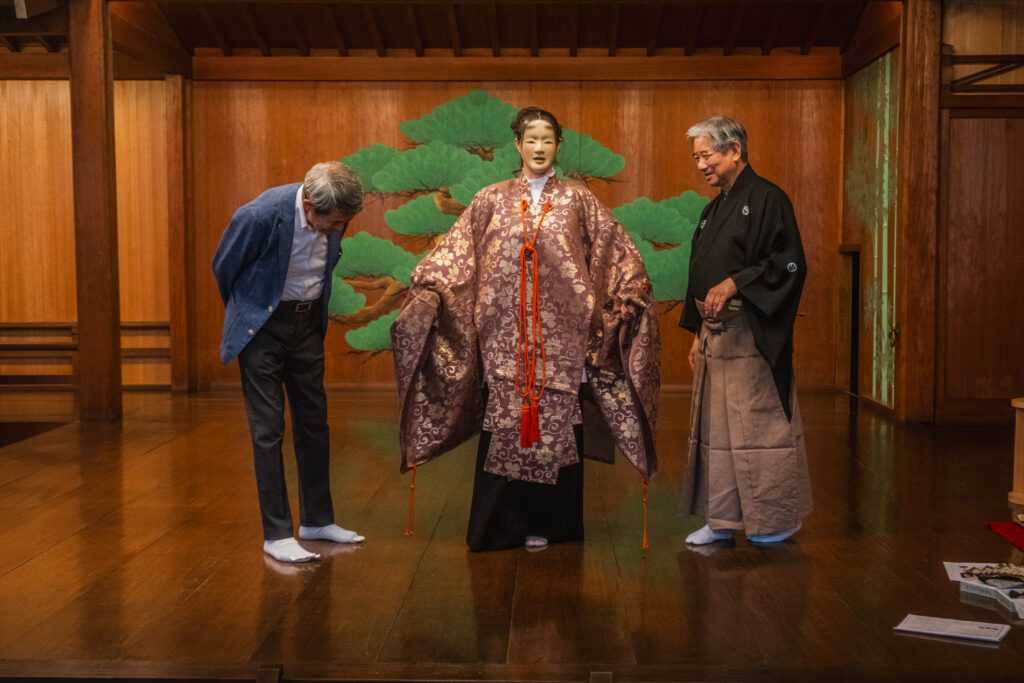
The guests were then dressed in noh costume, masked, and asked to walk on the stage.
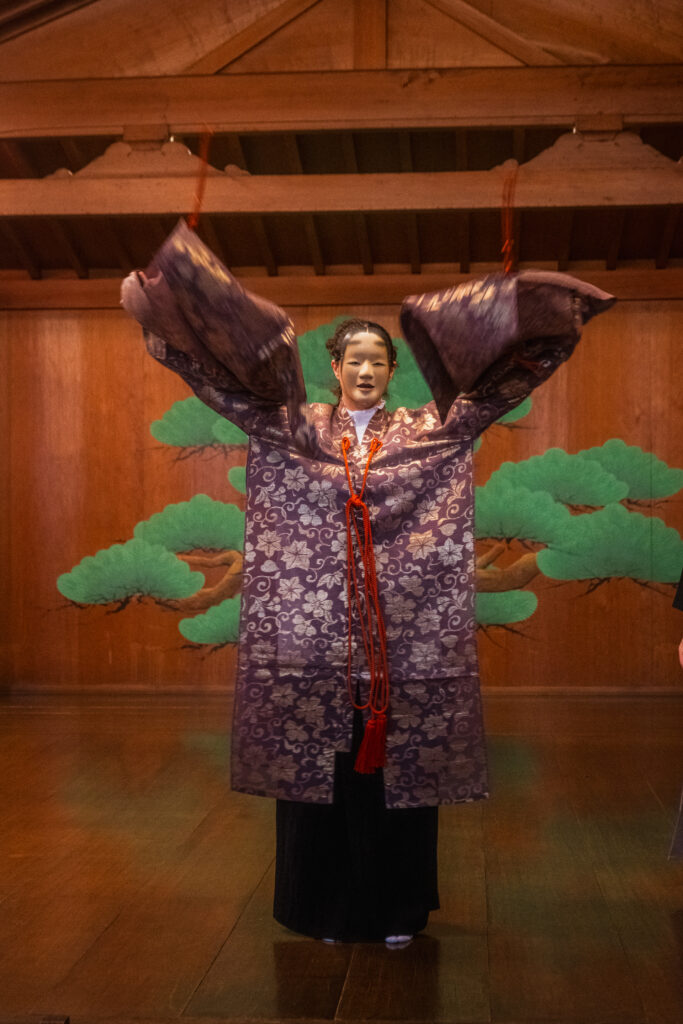
Noh costume is built from layered silk, with heavy patterning woven into the outer robes. The assembly carries considerable weight and does not flow with the body. The costume holds its own shape, and movement has to be produced inside it.
The eyeholes of a noh mask (omote) are barely larger than the pupil, and peripheral vision is almost entirely lost. The wearer cannot see his own feet either. What the metsuke-bashira described earlier is actually for only becomes concrete once you are standing on the stage with a mask on.
Movement is carried by suriashi, a walk in which the sole never leaves the floor and slides forward instead. Done correctly, the head stays at a constant height and the upper body does not rise and fall. Despite how it looks, it demands considerable physical control: knees soft, hips dropped, the upper body held steady while carrying the weight of the costume.
Wearing the mask also makes its shifts of expression legible from the inside. A slight change in the angle of the neck changes the expression entirely. The gap between what the wearer feels himself doing and what registers from the front is something you can only understand by putting a mask on.
The Private Performance
After the walking session, the guests took seats in the auditorium and the instructor performed for them.
In a theatre reserved privately, there is no other audience to absorb sound. The chant carries unamplified, and the stamps land with the jars resonating under the floor. Even the movement of the costume is audible.
Noh is an art built by paring movement back to the minimum. The principle appears in Zeami’s line that what is hidden is the flower, and it registers very differently from the back of a full house than it does from a few metres away. Securing the second set of conditions is the reason for the private performance.
Q&A and Photographs
The final segment took up the largest share of the session.
The guests listened closely to the instructor throughout and put questions to him as they arose, drawn from their own working experience as actors. For a theatre practitioner who has followed noh over the years, the chance to put those questions to a noh performer directly is rare. The session was conducted with consecutive interpretation. Our interpreter has studied noh himself and is well versed in the form, so specialized content and noh-specific terminology came through to the guests without loss of meaning. The guests asked in their own language and received the full answer rather than a simplified one.
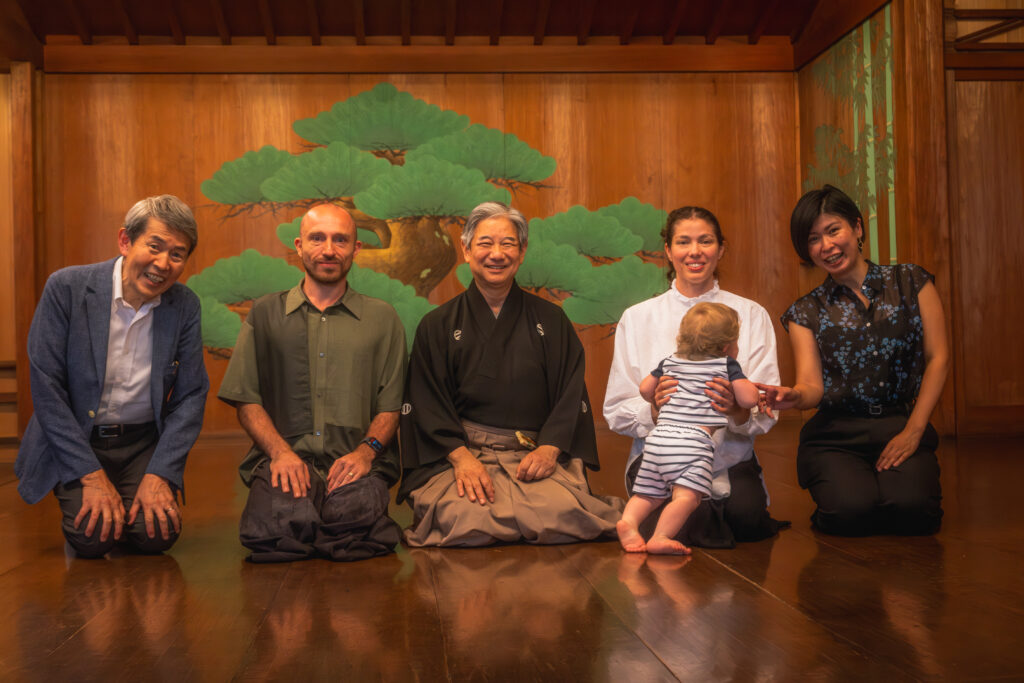
The instructor answered at the level the questions called for. The session closed with photographs on the stage.
The guests came asking for both the technique and the thinking behind it, and left satisfied on both counts.
Interested in a Deeper Cultural Experience in Kyoto?
This was not the kind of noh viewing that ends with watching a play from an audience seat. BASE KYOTO offers private sessions for individual guests, families, groups of friends, and MICE needs such as corporate training, incentive travel, and post-conference activities — each one built around the group’s interests, purpose, and schedule.
Sessions are conducted with consecutive interpretation, which also makes them well suited to mixed groups of Japanese and international guests. Interpreters are assigned by subject; noh sessions are handled by an interpreter with a background in the form.
What guests take away from the experience
- A noh theatre reserved exclusively for you, and time standing on the stage in mask and full costume — an experience an audience seat cannot offer
- Practical, first-hand knowledge from a working noh performer that goes beyond guidebook explanations — how the stage is built and what its elements mean
- A private performance at close range, and the conversation around it — a way into the knowledge and spirit behind noh and Japanese culture
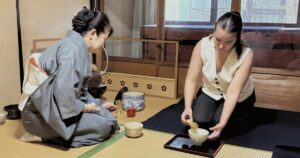
Beyond noh, BASE KYOTO offers the same kind of custom sessions in tea ceremony, wagashi making, zazen, and kyogen, drawing on close familiarity with Kyoto’s seasonal rituals and annual festivals — for solo travelers, small groups, and larger parties alike.
How to inquire
Send us your preferred experience, group size, and preferred dates through the contact form. We’ll follow up to discuss content, timing, and venue before proposing a program. This session was held at a noh theatre, but we can also bring the experience to hotel meeting rooms and banquet halls. Program content and duration vary by plan. This session ran 90 minutes, but the content and length are adjusted to your interests and budget. Once details are confirmed, payment is handled via PayPal.
Availability depends on the noh performer’s own performance schedule, so we recommend inquiring earlier than you would for other experiences.
What the day looks like (noh experience)
You’ll come to a noh theatre in Kyoto. The instructor opens with a talk on the history of noh and the structure of the stage, after which you’ll be dressed in costume, masked, and given time to walk on the stage. Costume goes on over your own clothes, so ordinary dress is fine. The second half is a private performance in the reserved hall, followed by a Q&A and photographs. Consecutive interpretation is provided by an interpreter versed in noh, so specialized content comes through clearly. No prior knowledge is required. The emphasis of the talk and the material chosen for the performance can both be discussed in advance according to your interests.
Whether you’re planning a visit on your own or arranging an experience for a larger group, feel free to reach out to BASE KYOTO.