What most Kyoto visitors never get to experience
Here’s something that surprises people who visit Kyoto multiple times: the problem isn’t that the famous places are overrated. They’re usually everything the guidebooks say. The problem is that you can’t think clearly when you’re surrounded by forty other tourists reading the same guidebook.
So the question becomes: where do you go when you want to experience Kyoto’s garden culture without the noise?
The answer — at least for late spring and autumn — is Hakuryuen (白龍園, “White Dragon Garden”), a privately owned moss and maple garden tucked into the forested hillside at the base of Kibuneguchi, in the far northeast of Kyoto city. It is open to the public only twice a year, for limited periods, with strict daily capacity limits. Those restrictions are not an inconvenience. They are the point.
Why this garden exists — and why it’s different
Hakuryuen was created and is maintained by Aono Co., Ltd., a Kyoto textile dyeing company. The garden is built on private land the company has tended over many decades. It was originally accessible only to invited guests and company associates.
The decision to open it to the public — partially, seasonally, under controlled conditions — reflects a particular philosophy: that a garden like this cannot coexist with mass tourism. The moment you allow unlimited access, you destroy what makes the place worth visiting.
This is not a commercial tourist attraction that has been dressed up to look refined. It is a refined private space that happens to accept a small number of visitors on carefully managed terms.
That distinction matters. It shapes everything about what you experience when you go.
The moss: what it is and why it takes so long
The single most striking feature of Hakuryuen is its moss. Not as a decorative element, but as the dominant texture of the entire garden floor and the surrounding hillside.
Moss in Japanese garden design is not merely aesthetic. It is a measure of time and care. Dense, healthy moss requires years — sometimes decades — to establish properly. The conditions have to be exactly right: consistent humidity, filtered light, undisturbed soil, and the complete absence of foot traffic on the areas where it grows. The fact that Hakuryuen’s moss is as thick and saturated as it is tells you something directly about how carefully this space has been protected.
This is also why the garden looks so different in different weather. In dry conditions, the moss appears a muted, dusty green. After rain, or during light drizzle, it absorbs water and the color deepens dramatically — a rich, saturated green that photographs cannot quite capture. The soil darkens. The stones glisten. Even the air feels different.
The ideal time to visit is the morning after rain. The ground is still wet, the moss has fully absorbed the water overnight, and the sky has begun to clear — which means you get maximum color saturation with enough ambient light to see the full depth of it. I visited on exactly such a morning, during a break in the rainy season. The path was still wet from the night before. As I climbed the stone steps, the sounds of the city fell away and were replaced by moving water and birdsong. The moss was at peak color. The few other visitors were spread across different levels of the hillside, and for long stretches the garden felt entirely private.
Visiting during active rain is a reasonable second option. The atmosphere is distinct and the crowds thin further, but the lower light levels flatten the color somewhat compared to a bright morning after overnight rain.
Ao-momiji: the overlooked season for Japanese maples
Most Western visitors learn about Japanese maple trees — momiji (もみじ) — in the context of autumn, when the leaves turn red and orange. This makes sense: the autumn color season is spectacular and heavily promoted.
What receives less attention is the summer stage of the same tree, called ao-momiji (青もみじ) — literally “green momiji.” The leaves are the same delicate, palmately lobed shape as in autumn, but they are a translucent, spring-to-summer green. When light passes through them, they glow from within. When rain falls on them, each leaf holds water droplets in its lobes.
Hakuryuen is essentially a showcase for ao-momiji at their peak. The entire garden is canopied by mature maple trees, and in late spring and early summer the overhead coverage is nearly complete. Walking through the space, you are underneath a living green filter. The light is indirect, soft, and constantly shifting when the wind moves the branches.
The combination of this canopy with the moss below creates a layered visual density — deep green at ground level, bright green above, and the occasional gap where direct light cuts through. It is a specific kind of visual experience, and it rewards slow movement.
Reading the garden’s structure: slope, water, bridges, and pavilions
Hakuryuen is built on a hillside, not on flat ground. This is important to understand before you go, both practically and aesthetically.
Practically: there are many stone steps, some of them steep. The path is not always even. In wet conditions, stone steps can be slippery. Appropriate footwear — closed-toe, with grip — is not optional. If you’re visiting on a rainy day, a waterproof jacket with your hands free is better than an umbrella on the narrower paths.
Aesthetically: the slope is the design. The garden doesn’t reveal itself all at once. As you ascend the stone steps, each turn opens a new framing of the trees, the water, and the structures. The experience is sequential, like moving through a series of composed scenes rather than viewing a single landscape.
Four structural elements define the visual character of the space:
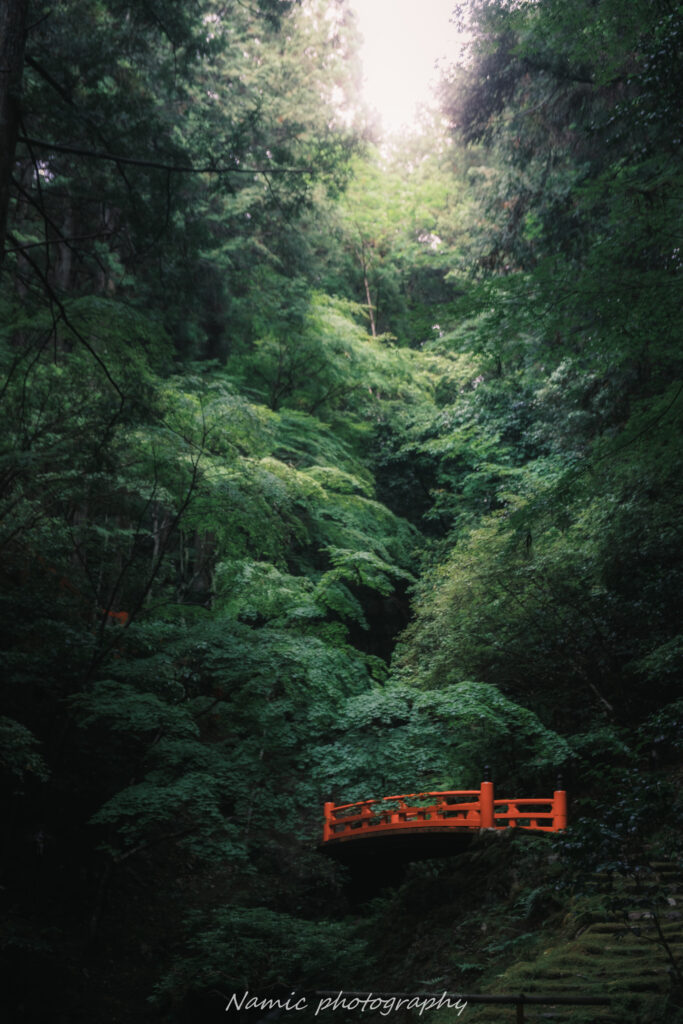
The vermilion bridge — A lacquered red wooden bridge arches over a stream at a lower level of the garden. The contrast between the red-orange lacquer and the surrounding green is not accidental. In Japanese sacred architecture, vermilion (shu, 朱) is used at Shinto shrines specifically because of its visual power against natural backgrounds. Here, the bridge plays the same role: a single strong color note that organizes the surrounding green into a coherent composition. When light filters through the canopy above onto the lacquered surface, the bridge almost seems to illuminate the space around it.
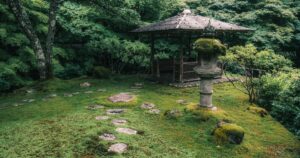
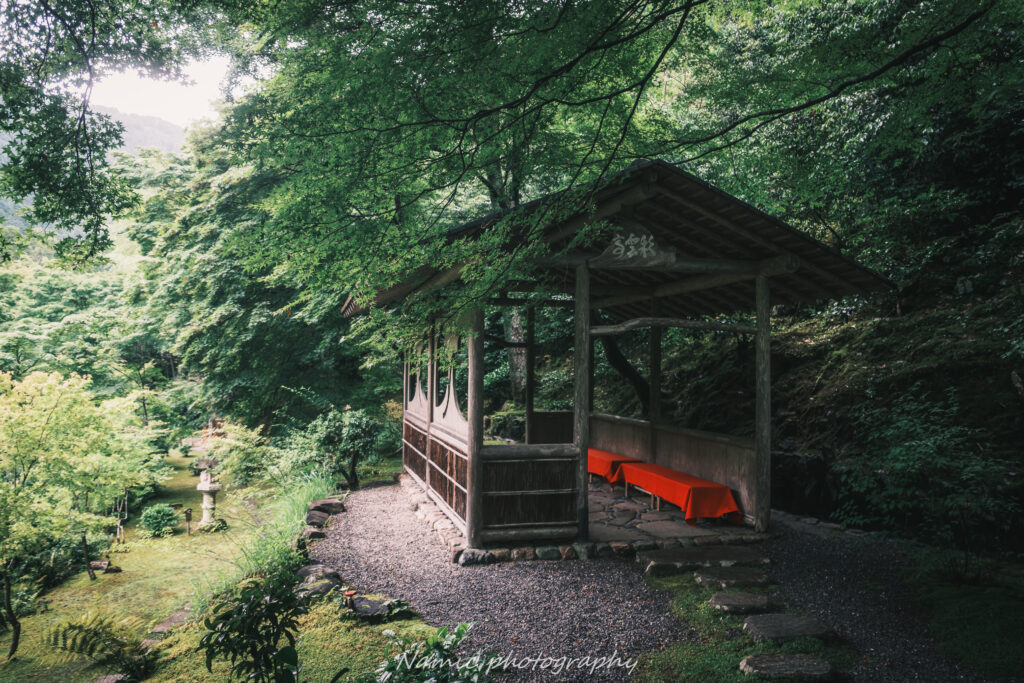
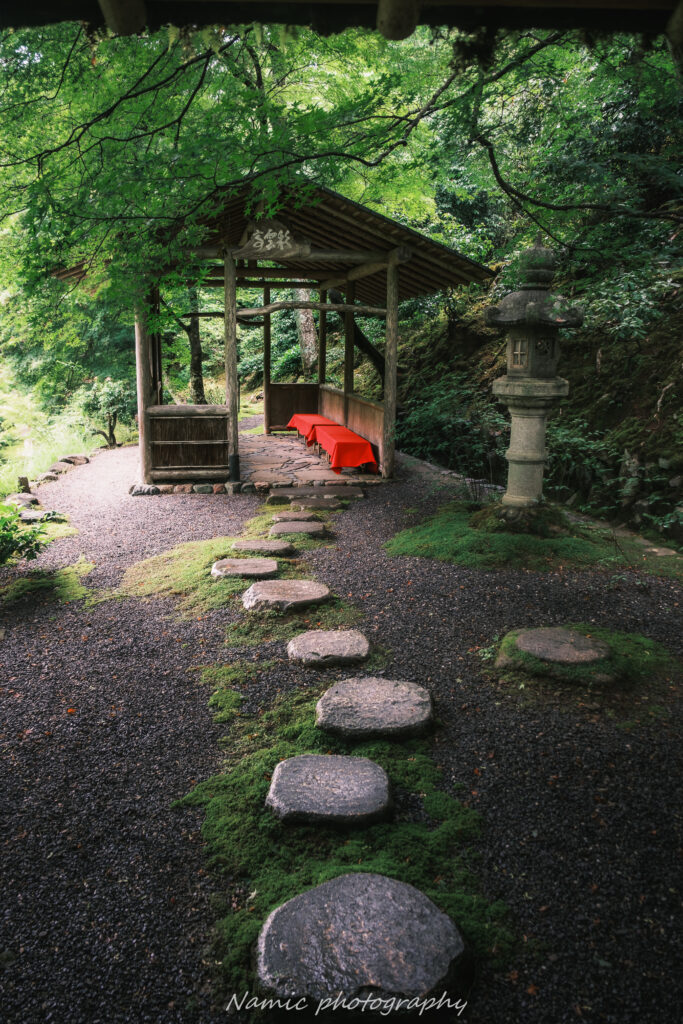
The rest pavilion with red cloth — Higher up in the garden, there is a timber-framed open pavilion with a bench covered in red fabric. The structure evokes noten (野点), the practice of outdoor tea ceremony in natural settings. Sitting here, the garden opens around you on three sides. The red cloth and the red bridge, viewed from this height, create a chromatic echo across the vertical layers of the garden.
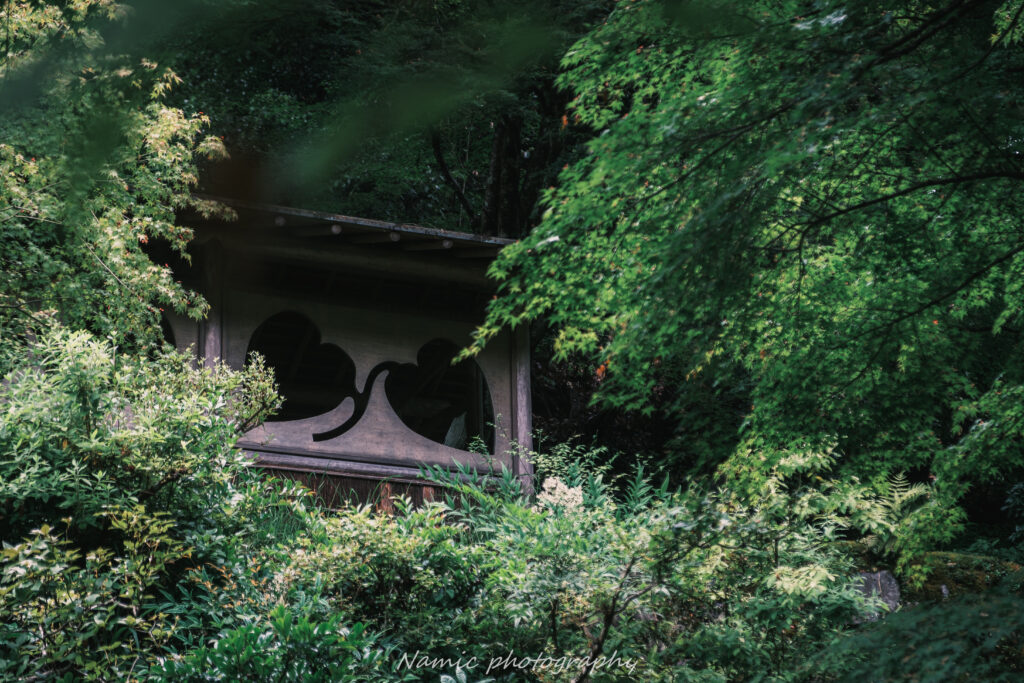
The kan-aoi window pavilion — Further into the garden, partially consumed by foliage, stands a dark-walled open structure whose walls are cut with large openings in the shape of kan-aoi (カンアオイ, Asarum spp.) leaves. Kan-aoi is a low-growing perennial plant native to the forested hills of the Kyoto region — the same hills visible through these windows. The leaf shape is broadly heart-shaped with a pointed tip, and the cutouts replicate it precisely: two leaves side by side, connected at the stem.
From the outside, the structure reads as a wall with decorative openings. Step inside, and the logic reverses. The dark interior turns each opening into a frame. The mountain forest beyond — layers of maple, cedar, and broadleaf trees in varying shades of green — is compressed into two leaf-shaped panels of living color against a black surround. The effect is not accidental. This is a deliberate application of shakkei (借景, “borrowed scenery”), a classical Japanese garden technique in which exterior landscape is captured through an architectural opening and incorporated as part of the garden’s visual composition. What makes this iteration unusual is that the frame itself is botanical — the plant that grows in these hills is the shape through which you view them.
This is the kind of detail that rewards slow looking. Visitors who pass through quickly see a decorative building. Visitors who stop, step inside, and let their eyes adjust see something else entirely.
The structure half-consumed by green — Deeper in the garden, a building sits almost entirely within the surrounding vegetation. It is visible but not fully revealed — which is a deliberate compositional strategy common in Japanese garden design. Gardens are designed to withhold as much as they show.
What the guidebooks don’t tell you
A few things worth knowing that don’t appear in most standard information sources:
The morning after rain is the best time to visit. The moss reaches its deepest color when it has absorbed a full night of rain and the light has returned. If your visit happens to fall on a day after overnight or early-morning rain, that is not bad luck — it is ideal timing. Visiting during active drizzle is a worthwhile second choice; the atmosphere is distinct, even if the color reads slightly flatter in low light.
The garden is legitimately quiet. The capacity restrictions mean that even on a busy day, you are not sharing the space with large crowds. On a weekday in mild weather, you may have entire sections to yourself for ten or fifteen minutes at a time.
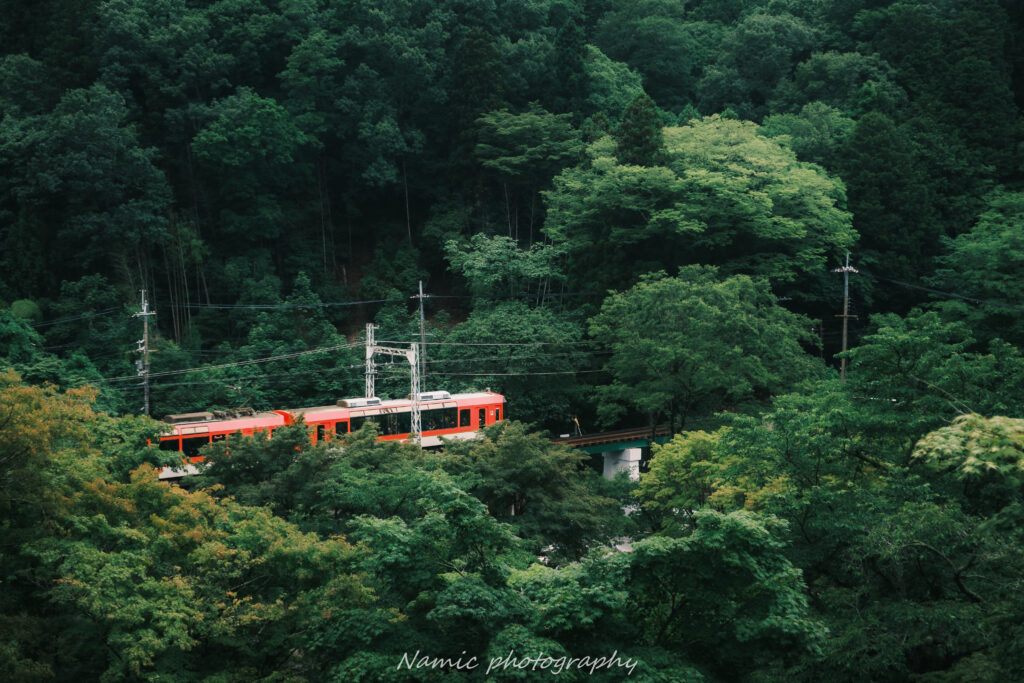
The approach matters. The walk from Ninose Station (二ノ瀬駅) on the Eizan Electric Railway Kurama Line takes approximately five to seven minutes through a quiet residential and forested area. This transition — from train to town to garden — is itself worth paying attention to. Kyoto’s northeastern edge has a different texture from the central tourist districts.
Bring a real camera if you have one. Smartphone cameras handle bright, high-contrast scenes well, but the low-light conditions under the maple canopy in overcast weather tend to produce flat results. A camera with manual exposure control, or at least the ability to expose for shadows, will capture the depth of the green more accurately. The kan-aoi window is a particularly strong subject: the contrast between the dark interior and the bright forest outside is extreme, and managing that exposure gap is easier with manual control.
2026 Spring Special Opening: Practical Information
The 2026 spring public opening runs through June 21st.
Key details:
- Advance reservations are required through the official online booking system, by 5:00 PM the day before your planned visit
- Walk-in entry on the day of your visit is possible if slots remain, but the walk-in fee is higher than the advance reservation price — plan ahead
- Access: Ninose Station (二ノ瀬駅) on the Eizan Electric Railway Kurama Line, approximately 20 minutes from Demachiyanagi Station (出町柳駅). From Ninose, the garden is a 5–7 minute walk
- The garden involves significant elevation change via stone stairs. Visitors with mobility concerns should assess accordingly
- Photography is generally permitted; please be considerate of other guests
For current reservation links and any updates to access procedures, check the official Aono Co. website directly before your visit.