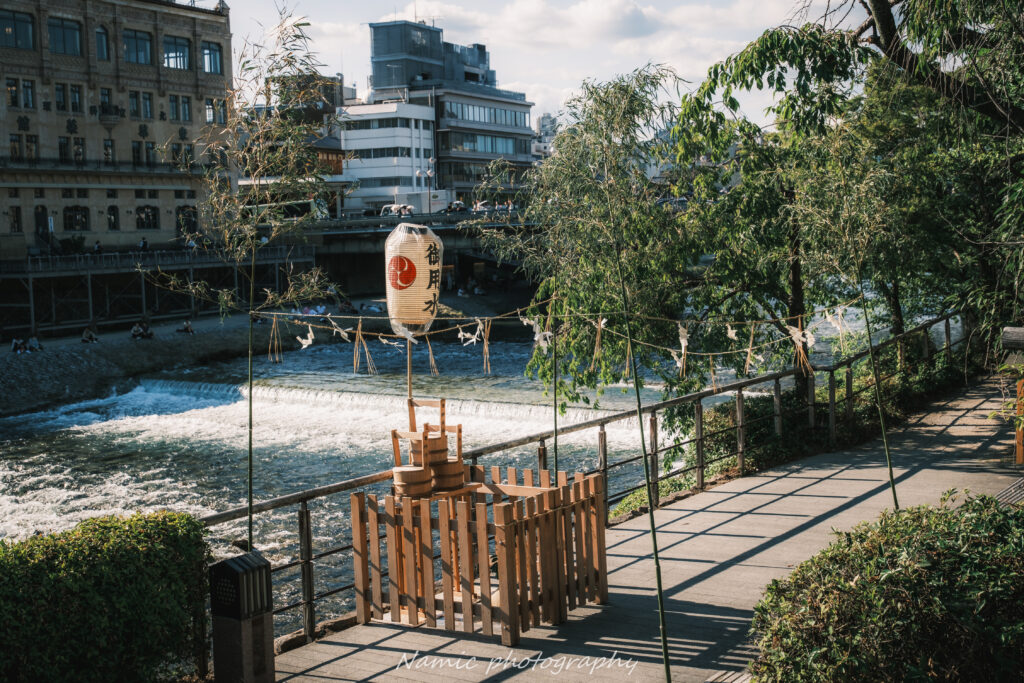
On July 10, we attended the Omukae Chochin (Welcoming Lantern Procession) and the Mikoshi Arai (Sacred Palanquin Purification Ceremony), two events of Kyoto’s famous Gion Festival.
On this night, a sacred ritual called the Mikoshi Arai takes place: a mikoshi (portable shrine) is carried to the Shijo Ohashi Bridge and purified with water from the Kamo River. To welcome that mikoshi, a lantern procession called the Omukae Chochin sets out in the early evening, and great torches (taimatsu) purify the road along which the mikoshi will pass. These three events are inseparably linked as one continuous flow of ritual — and from dusk into night, it was a special evening where we could feel Kyoto’s traditions and sacred atmosphere with all our senses.
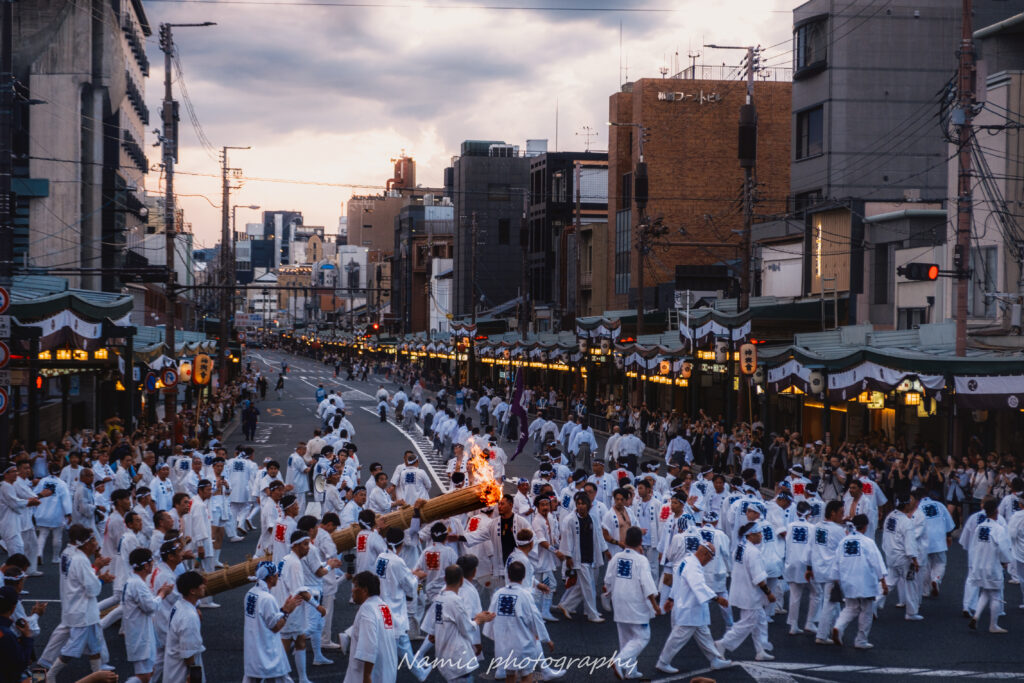
The Omukae Chochin: Lantern Light and Festival Music Filling the Streets
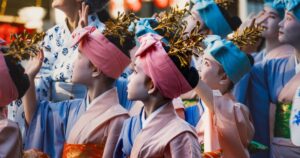
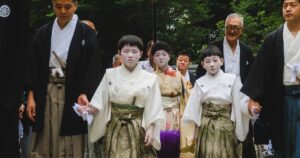
The Omukae Chochin is organized by the Gion Mantokai association, and the stars of the procession are local children.
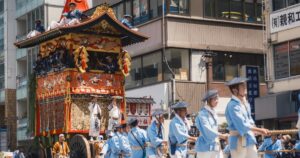
The procession departs Yasaka Shrine at 4:30 p.m. In front of the shrine’s gate appears the lead group, carrying a large lantern inscribed with the word “Omukae” (“Welcome”), followed by musicians from one of the festival’s yamahoko floats. To the light, cheerful rhythm of the Gion-bayashi festival music — the distinctive “kon-chiki-chin” of flutes, bells, and drums — the procession slowly makes its way along Shijo Street.
Interestingly, a different float takes on the honor of providing this music each year. In 2025 it was Kita Kannon Yama, and this year, 2026, it was Niwatori Hoko (the Rooster Float).
The procession heads to Kyoto City Hall, where the children perform traditional dances, then returns to Yasaka Shrine via Teramachi Street. With locals walking alongside carrying handheld lanterns and festival music echoing through the streets, the lantern light glowing brighter as dusk falls, a Kyoto night begins that feels like stepping back in time.
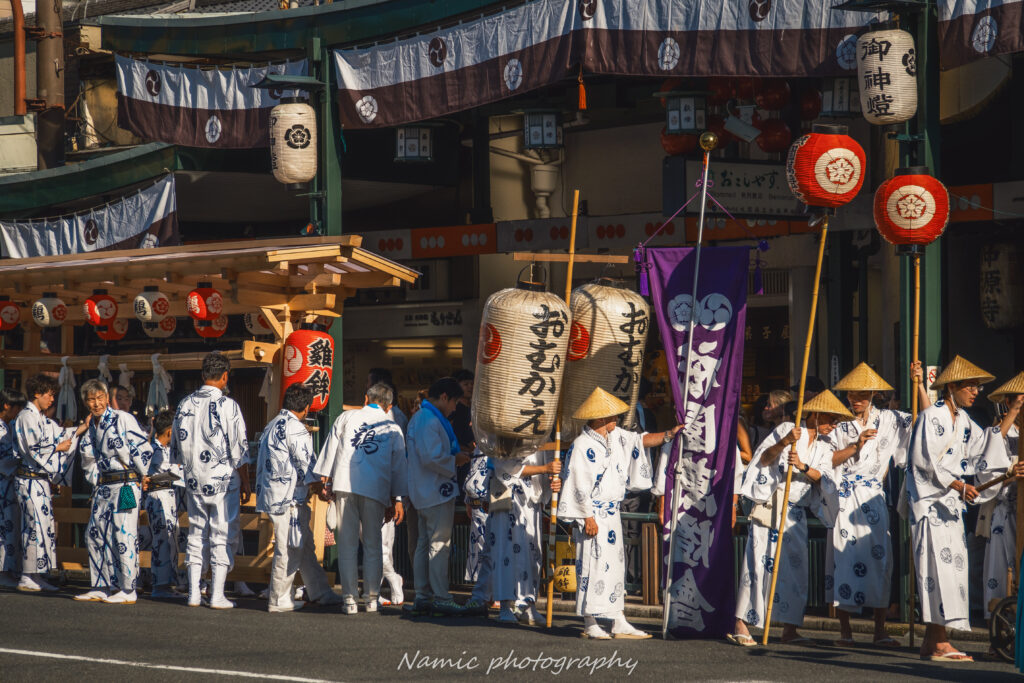
Great Torches Purify the Path of the Mikoshi
Around 7:00 p.m., the torches are lit at Yasaka Shrine, and despite the crowds, the grounds fill with a solemn atmosphere.
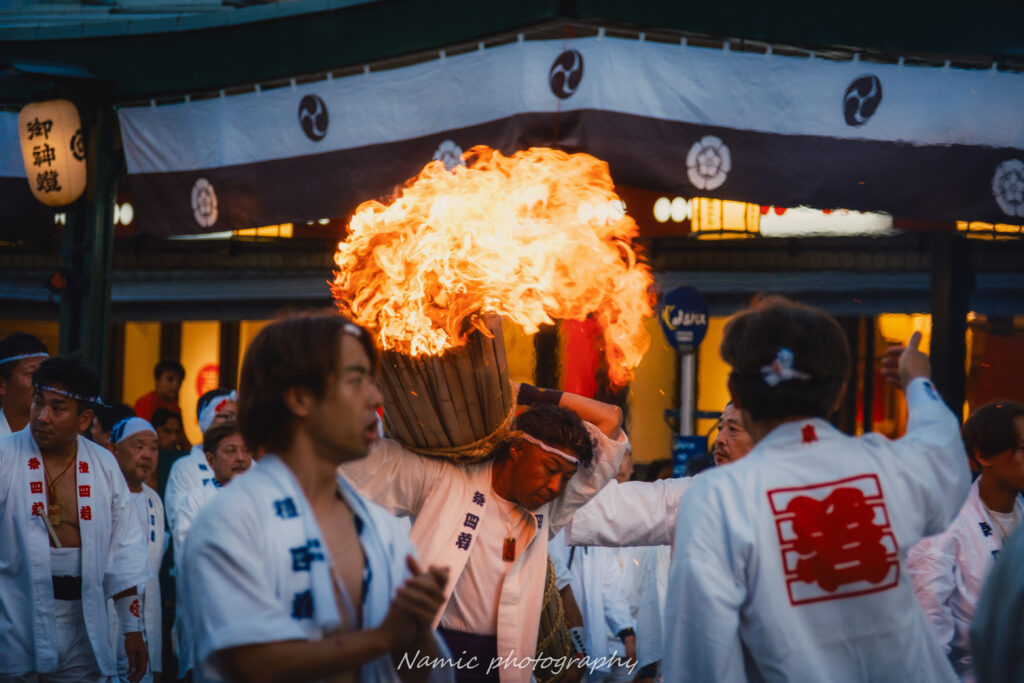
First, a torch procession travels to the Shijo Ohashi Bridge and back, performing a ritual to purify the road the mikoshi is about to travel. Just like the mikoshi, the torches are carried to the chant of “Hoitto! Hoitto!” as they make the round trip to the bridge. Fire cleanses the path before the deity passes — it is this role of the torches that makes the purification ceremony possible. As the torch flames sway through the streets, Kyoto gradually takes on the atmosphere of a festival night.
The Mikoshi Arai: Purifying the Sacred Palanquin with Water from the Kamo River
Once the torches return, it is time for the mikoshi to depart.
The mikoshi purified in this ceremony is the Nakagoza, which enshrines Susanoo-no-Mikoto, the principal deity of Yasaka Shrine. Of the shrine’s three mikoshi, the Nakagoza is the one enshrined at the center of the Buden (ceremonial stage).
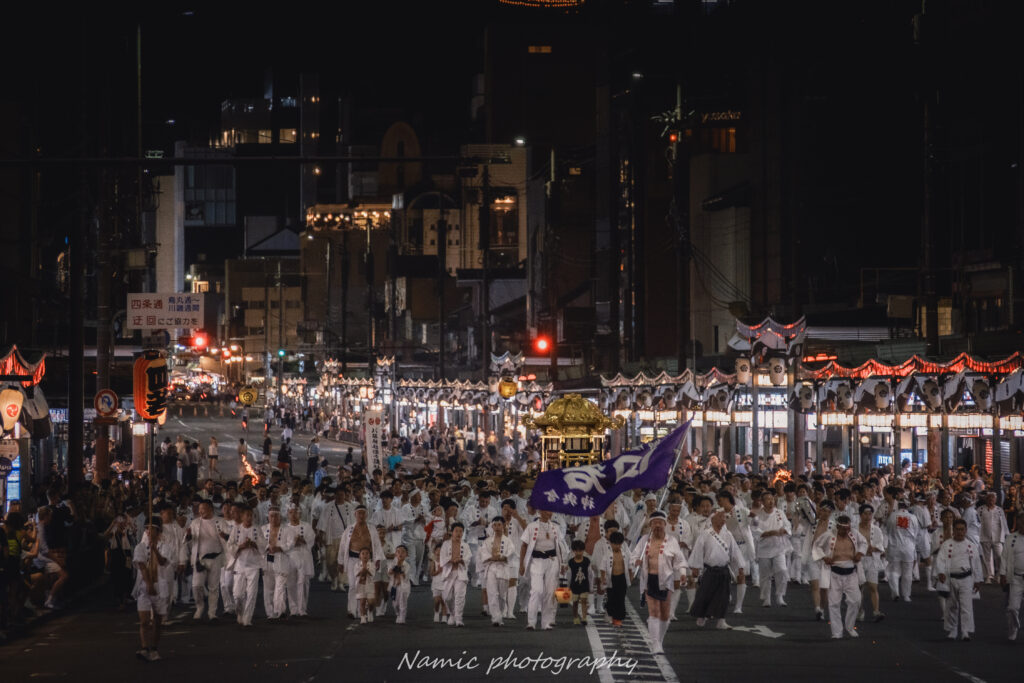
After being blessed by Shinto priests, the Nakagoza is powerfully hoisted onto the shoulders of its bearers and carried down Shijo Street toward the Shijo Ohashi Bridge, to the same spirited chant of “Hoitto! Hoitto!” that accompanied the torches. The mikoshi now advances along the very path the flames have just purified — this continuity is the true highlight of the night’s rituals.
Then, at around 8:00 p.m. on the Shijo Ohashi Bridge, the Mikoshi Arai — the purification of the mikoshi with water from the Kamo River — is solemnly performed. The water used here was in fact drawn from the river earlier that same day, in a 10:00 a.m. ritual called the Shinyosui Kiyoharai-shiki (Sacred Water Purification Ceremony). From the quiet morning ceremony to the night’s grand ritual, the entire day is carefully built up step by step — a testament to the weight and depth of this sacred event.
The flickering torch flames, the chants of the bearers, and the sacred water of the Kamo River — it was a mystical, sacred moment where fire and water meet, and the crowds filling the bridge watched in quiet awe.
There is a belief that being touched by the water droplets scattered during the purification will keep you healthy and free from summer illness for the coming year, and ward off misfortune — which is why so many people press close to the mikoshi, hoping to witness the moment of purification up close.
The Mikoshi Arai is an important rite of preparation: purifying the mikoshi to welcome the deity ahead of the Shinkosai procession on July 17, when the mikoshi sets out through the shrine’s parish neighborhoods. A second Mikoshi Arai is held on July 28, after the festival’s main events have concluded.
At the Stone Steps of the West Gate, the Lantern Procession Welcomes the Mikoshi Home
When the Nakagoza, freshly purified at the Shijo Ohashi Bridge, returns to Yasaka Shrine, the Omukae Chochin procession welcomes it at the foot of the stone steps below the Nishiromon (West Gate). The mikoshi returning to the shrine, greeted by the glow of lanterns — this is the very scene from which the “Welcoming Lanterns” take their name, and the moment when the three rituals of the night become one.
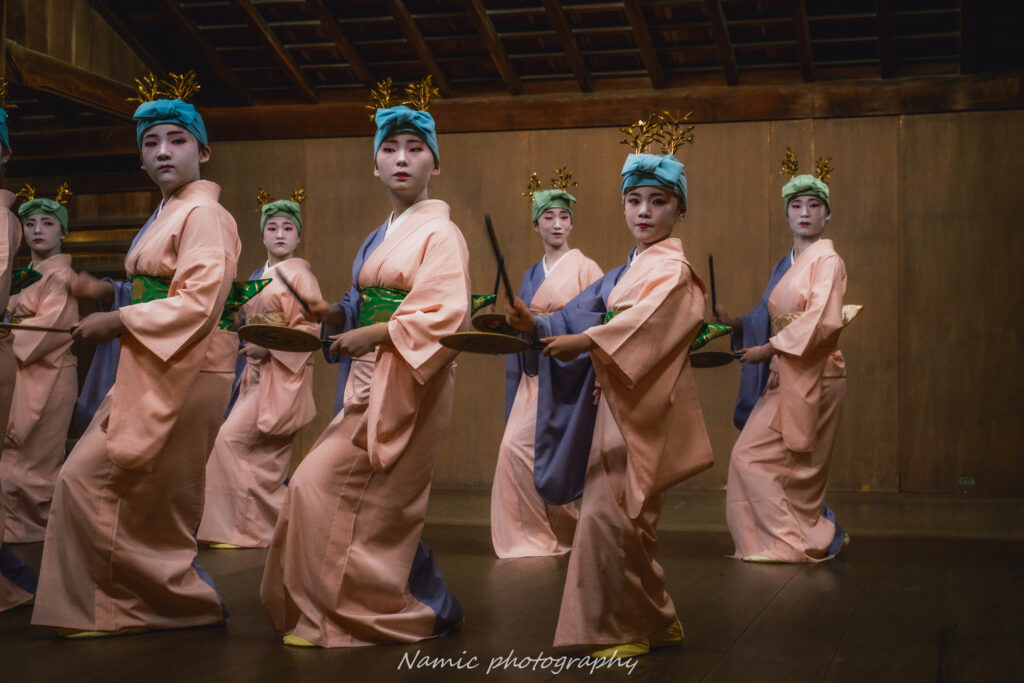
After the mikoshi’s return, the children performed the Sagi-mai (Heron Dance) and traditional Japanese dances in the shrine grounds as offerings to the deity. We found ourselves captivated by their graceful movements, dancing as elegantly as white herons. It was deeply moving to see that the culture of offering performing arts to the gods is still lovingly passed down today.
Looking for an Authentic Cultural Experience in Kyoto?
The Omukae Chochin, the great torches, the Mikoshi Arai — the Gion Festival is so much more than the famous float processions. It is filled with sacred rituals carried and passed down by local people and their children. Attending events like these, you come to realize that Kyoto’s culture is not something merely to be “seen” — it is a living practice, woven into everyday life to this day.
At BASE KYOTO, we offer tailor-made cultural experience tours designed around your interests.
✔️ Want insider information you won’t find in guidebooks?
✔️ Want to experience Japanese culture in depth?
✔️ Want to encounter authentic, living traditions?
If so, please feel free to get in touch. We would be delighted to help make your journey to Kyoto an unforgettable cultural experience.