If you ask someone in Kyoto what June feels like, you’ll get a slight grimace before anything else. There’s no cherry blossom crowd, no major festival pulling people from across the country. June is the quiet stretch between spring and the start of Gion Matsuri — humid, damp, and easy to overlook.
But spend a few days here in June and pay attention to what people around you are doing, and a pattern emerges. A particular sweet appears in every wagashi shop window. Shrine gates start growing large woven rings of grass. And if you walk through the right neighborhood after dark, you’ll hear the unmistakable rhythm of festival music drifting from buildings that look, from the outside, like nothing is happening at all.
None of this is for tourists. It’s just what June in Kyoto looks like, if you know where to look.
The Sweet That Marks the Halfway Point of the Year
What Minazuki Is
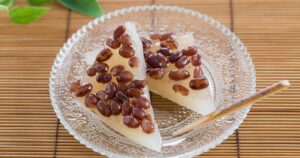
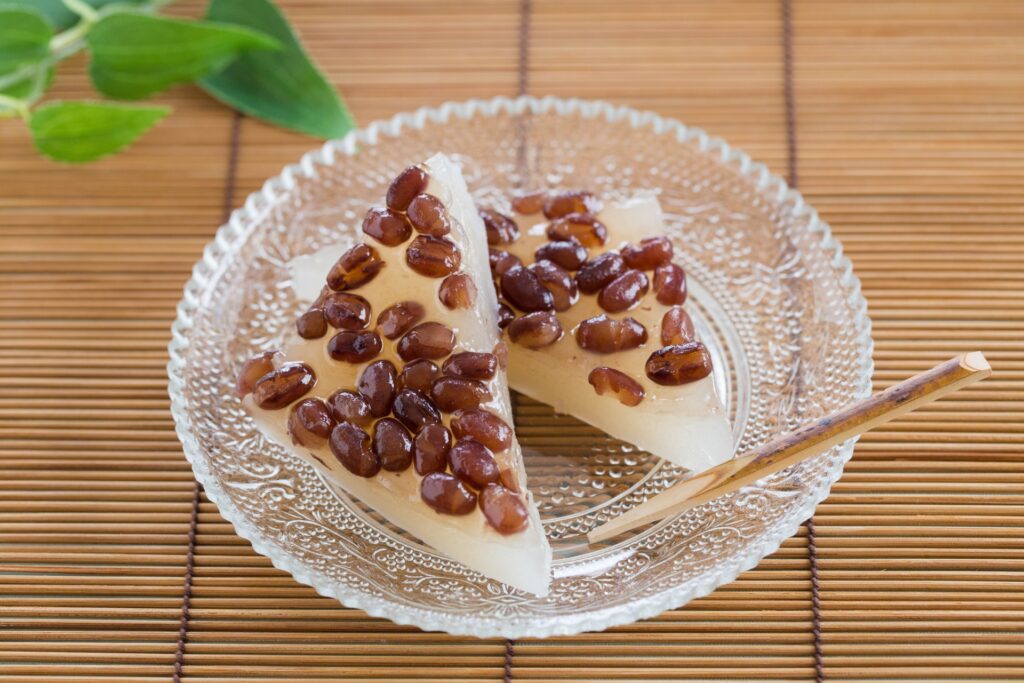
Walk past a wagashi (Japanese confectionery) shop in June and you’ll see triangular pieces of a translucent white jelly-like sweet called minazuki (水無月), topped with a layer of soft-cooked red adzuki beans.
The base is made from uiro — a steamed cake of rice flour and water, similar in texture to mochi but firmer and less sticky. It’s mildly sweet, almost neutral. The visual is simple: white triangle, red beans on top. And it’s been made in essentially this same form for centuries.
The name minazuki is the old lunar-calendar name for the sixth month, and it literally translates to “month without water.” That sounds odd for a month that sits in the middle of Japan’s rainy season, but the most common explanation is that it refers to rice paddies — by this point in early summer, all available water had been diverted into the fields for planting, leaving other sources temporarily depleted.
The name is interesting. But it’s not the real story behind the sweet.
Why This Sweet Exists at All
Before air conditioning, before electric fans, summer in Kyoto was — and still is — genuinely difficult. The city sits in a basin surrounded by mountains on three sides, which traps humidity. Once the rainy season starts in June, heat and moisture arrive together and don’t let up for weeks.
During the Heian period, the imperial court had a ritual tied to the start of summer: ice that had been cut and stored over the winter (itself a major undertaking) was distributed to court nobles. Eating shaved ice on the first day of summer was believed to ward off the heat and the illnesses that came with it.
The problem was that ice was extremely valuable. Only the highest-ranking court members had access to it. Everyone else in Kyoto knew the ritual existed, knew what it was supposed to do, and had no way to participate.
Minazuki was the answer.
The white uiro base is shaped to represent a block of ice. The triangular form isn’t decorative — it mirrors the angular shape you’d get from cutting a large ice block into pieces. And the red adzuki beans on top aren’t just a topping for flavor. In Japanese folk belief, the deep red of adzuki beans has long been associated with warding off bad luck and illness.
Put together: a sweet shaped like ice, topped with beans believed to repel misfortune, eaten at the start of summer by people who couldn’t access the real thing but wanted the same protection, the same symbolism, in a form they could actually have.
Eating minazuki in June still carries that same idea today — a small acknowledgment that the hard part of summer is coming, and you’re getting ready for it.
When and Where to Eat It
Minazuki is sold throughout Kyoto’s wagashi shops all month, but the date that matters most is June 30th.
That evening, shrines across the city perform a purification ritual called nagoshi no harae (夏越の祓), and eating minazuki afterward is traditional. The idea is to clear away the accumulated impurities of the first half of the year so the second half can begin clean.
If you’re in Kyoto at the end of June, try visiting a wagashi shop in the late afternoon on the 30th. Many sell out by evening — not because shops are limiting supply, but because everyone in the neighborhood has the same idea on the same day, every year.
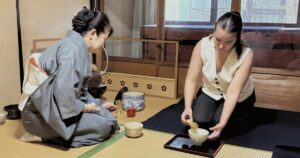
Moments like this — a seasonal sweet, a quiet tea room, a ritual most visitors never see — are exactly what we design into our custom cultural experiences. If you’re planning a future trip to Kyoto, we’d love to build a private tea ceremony around the season you’ll be visiting in.
The Grass Rings Appearing at Shrine Gates
On that same date — June 30th — something else happens across the city’s shrines.
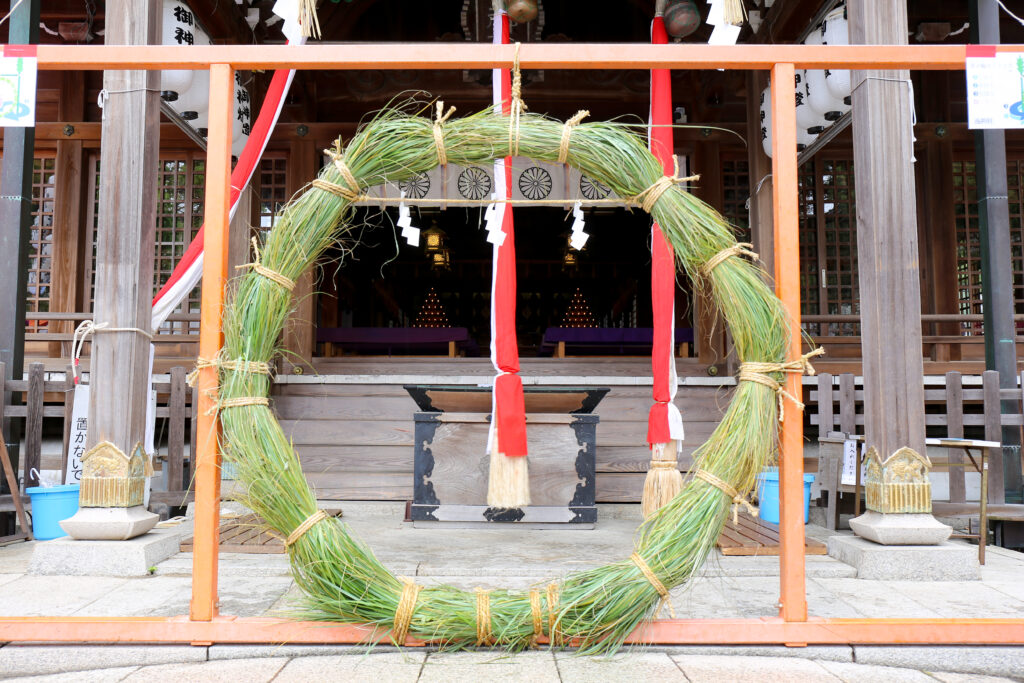
A large ring woven from chigaya, a type of reed grass, is set up at the entrance to the main hall. It’s roughly two meters tall, wide enough to walk through, and mounted on a wooden base in a near-perfect circle. This is called the chinowa (茅の輪).
Walking through it is called chinowa-kuguri. The basic idea is to pass through the ring while tracing a figure-eight pattern, symbolically leaving behind the misfortune and impurity accumulated over the first half of the year before approaching the main hall.
The exact walking pattern can be confusing the first time. Generally: pass through the ring and turn left, walk a full loop around the outside, pass through again and turn right, walk another full loop, then pass through one final time and proceed to the main hall. Most shrines post a diagram near the ring, so you don’t need to memorize it — just follow the signage on site.
Why Chigaya Grass, Specifically
The choice of grass isn’t random.
Japan’s two oldest historical texts, the Kojiki and the Nihon Shoki, record a story involving the deity Susanoo-no-Mikoto, who, while traveling, asked for a night’s lodging. A poor man named Somin Shorai offered what hospitality he could. Susanoo later returned and gave Somin’s descendants a talisman made of chigaya grass, telling them that wearing it around the waist would protect them from epidemics.
From that story onward, chigaya grass became associated with divine protection. The chinowa is, in effect, a large-scale version of that talisman. Walking through it means walking through that protection.
This ritual happens at the year’s midpoint, on June 30th. A mirrored version — toshikoshi no harae (年越の祓) — takes place on December 31st. Together, they mark the two points in the year where people symbolically reset.
Where to Find Chinowa in Kyoto
Many shrines set up a chinowa around June 30th, but a few are particularly worth knowing:
- Kitano Tenmangu — large in scale, and one of the busier locations for this ritual
- Jonangu — sets up not just the shrine ring, but also a separate ring sized for cars in the parking area
- Yasaka Shrine (Gion) — also the heart of Gion Matsuri, which begins ramping up just days later, so the grounds already carry a different energy by late June
Beyond these three, chinowa appear at many other shrines around the city, including locations like Anrakukobi Shrine, Kamigoryo Shrine, Matsunoo Taisha, and Heian Shrine.
Gion Matsuri Is Already Underway — Quietly
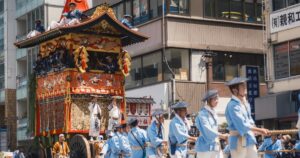
Yamaboko-cho (山鉾町) refers to the cluster of neighborhoods around Shijo and Karasuma streets where the yamaboko — the large decorated floats — are assembled during Gion Matsuri.
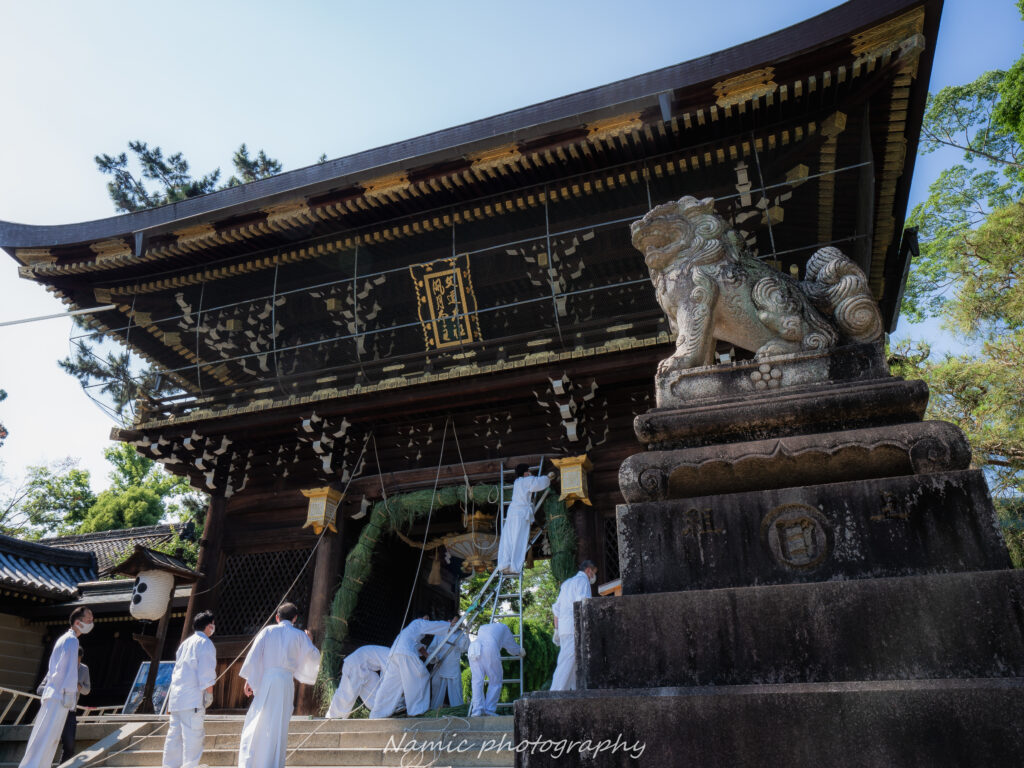
Most visitors know Gion Matsuri for its float processions on July 17th and 24th. Officially, though, the festival begins on July 1st with a ceremony called kippu-iri (吉符入り). And the preparation for all of it starts in June.
Inside the neighborhood meeting halls — buildings maintained for generations by the families responsible for each float — the inventory check begins. Ropes are inspected. Kesoyhin (懸装品), the textile decorations that adorn each float, are brought out and examined for damage. Some of these textiles are centuries old, and several originated from as far away as Flanders and Persia, having arrived in Japan through historical trade routes. Music groups gather to rehearse, and logistics meetings take place.
This is also when the chimaki (粽) sold during the festival are made. These aren’t the edible rice dumplings the word usually refers to — Gion Matsuri’s chimaki are protective talismans, made by hand-folding thin bamboo leaves and bundling them together, meant to be hung at a home’s entrance. Each yamaboko neighborhood produces its own version, and thousands are made by hand. By June, this work is already in progress.
If you walk through this area in June, especially on weekend evenings, you’ll often hear konchikichin — the distinctive rhythm of Gion Matsuri’s festival music — carrying through streets that are otherwise quiet, well before the tourist crowds arrive in July.
From the outside, nothing looks like it’s happening. But there’s a sense that the neighborhood is quietly building toward something larger — and that anticipation is worth experiencing in its own right.
One More Thing Kyoto Locals Do in June
There’s a final June tradition that no guidebook mentions. It doesn’t involve a specific shrine, a specific sweet, or any historical background at all.
People complain about the heat and humidity. By June, the rainy season has started, and the standard greeting shifts to some version of “muggy again today, isn’t it.”
Minazuki gets eaten. Chinowa get walked through. Festival preparations move forward. And everyone adjusts, slowly, to Kyoto’s humidity. That’s June, from the inside.
Practical Notes for Visiting Kyoto in June
If your trip falls in June, a few things are worth keeping in mind:
- Minazuki is sold all month, but many shops sell out by the evening of June 30th
- Chinowa-kuguri takes place at most shrines on June 30th, though some shrines set up their rings as early as around June 20th
- Yamaboko-cho (around Shijo-Karasuma) is worth an evening walk — you may catch festival music rehearsals weeks before the main event in July
June is humid, and the rain is frequent. Bring water, expect rain, and take the pace of the season as it comes.
For visitors who want to understand these seasonal rhythms in more depth — the symbolism behind a single sweet, the history embedded in a shrine ritual, or the slow build-up to one of Japan’s major festivals — these are exactly the kinds of details we build into our custom cultural experiences in Kyoto.
If June’s quieter pace appeals to you, it’s also one of the better times to arrange a private tea ceremony or temple visit without the crowds of spring or autumn.