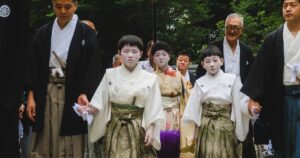
Gion Matsuri, Kyoto’s largest festival, does not begin with the parade everyone photographs in mid-July. It begins on the morning of July 1, inside Yasaka Shrine, with a chosen boy of around nine or ten years old circling the main hall three times in prayer. There are no floats yet, and no festival music — but there is a real crowd: the boy’s parents and relatives, his two young attendants, and a dozen or so neighborhood officials trailing behind him. This ceremony is called Osendo no Gi (お千度の儀), and it belongs to Naginata Hoko, the float that leads the entire procession two weeks later.
I went to see this opening ceremony of Gion Matsuri again this year. This article covers Naginata Hoko’s Osendo no Gi, and the older Kyoto custom behind it.
What Gion Matsuri Is, and Why This Day Matters
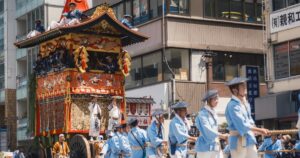
Gion Matsuri runs the entire month of July and belongs to Yasaka Shrine, one of Kyoto’s major Shinto shrines, located at the eastern end of Shijo Street. The festival’s best-known event is the yamaboko junko, the procession of elaborately decorated floats through the city center on July 17 (and again on July 24 for the smaller second procession). Naginata Hoko is one of over 30 floats, but it holds a fixed position: it always leads.
The reason is practical, not ceremonial. Right after the procession begins, a sacred rope marking the boundary of the shrine’s ritual space has to be cut. That job falls to a living child riding on top of Naginata Hoko — the only float in the entire festival that still carries a real child rather than a doll. That child is called the chigo (稚児).
July 1 is the first time that year’s chigo appears in public in an official capacity. It is also the day the float’s neighborhood association formally reports the appointment to the shrine’s deity and prays for the safety of the entire month’s rituals. That report and that prayer are Osendo no Gi.
Who the Chigo Is, and How the Role Works
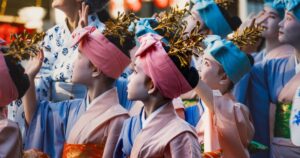
Each year, one boy — traditionally around eight to ten years old, historically chosen from families connected to the Naginata Hoko neighborhood, though in recent years candidates have come from across Kyoto — is selected to serve as chigo. Two more boys are chosen as his attendants, called kamuro (禿).
Once selected, the chigo is formally adopted by the neighborhood association in a betrothal-style ceremony (結納の儀, yuinō no gi) held in June. From that point until the festival ends, he is treated as a role, not simply a child performing in a costume. On July 13, in a separate ceremony called chigo shasan, he is ritually promoted to the rank of a minor court official and is considered, from that day forward, a messenger of the deity — at which point he is no longer permitted to let his feet touch the ground and must be carried.
On July 1, none of that has happened yet. The chigo still wears an ordinary, if formal, outfit known as suzumi shōzoku — a haori jacket and hakama trousers — and walks on his own feet. This is one of the only points in the entire monthlong festival where the public can see him do so.
What Is Osendo? The Custom Behind the Ceremony
Osendo (お千度), sometimes called osendo-mairi, is not specific to Gion Matsuri. It is a much older and more general Kyoto neighborhood practice: residents of a district visit their ujigami — the Shinto guardian deity of that specific area — and pray together for the safety of the community.
The literal meaning of osendo is “a thousand visits.” Traditionally, this meant circling a shrine’s main hall, or walking between its gate and hall, one thousand times, with a prayer offered at each pass. In practice, no single person walks a thousand laps. Neighborhoods divide the number among everyone present. If fifty residents attend and each completes twenty circuits, the group has collectively completed one thousand — and the shrine records it as such. Some shrines issue wooden tally sticks or slips of paper, one per lap, so participants can track their share of the total.
This custom is tied historically to periods of crisis rather than routine devotion. Yasaka Shrine’s own signage traces the practice to a purification rite performed during epidemic outbreaks, including a well-documented instance during the 1858 cholera epidemic, when neighborhoods came in large numbers to pray collectively for protection. Many Kyoto districts still hold their own osendo each spring or autumn today, independent of Gion Matsuri entirely.
Naginata Hoko’s July 1 ceremony carries this older tradition into the festival calendar. It is not a scaled-down version of osendo — it is the same practice, applied specifically to the chigo’s appointment.
Can You Watch Osendo no Gi?
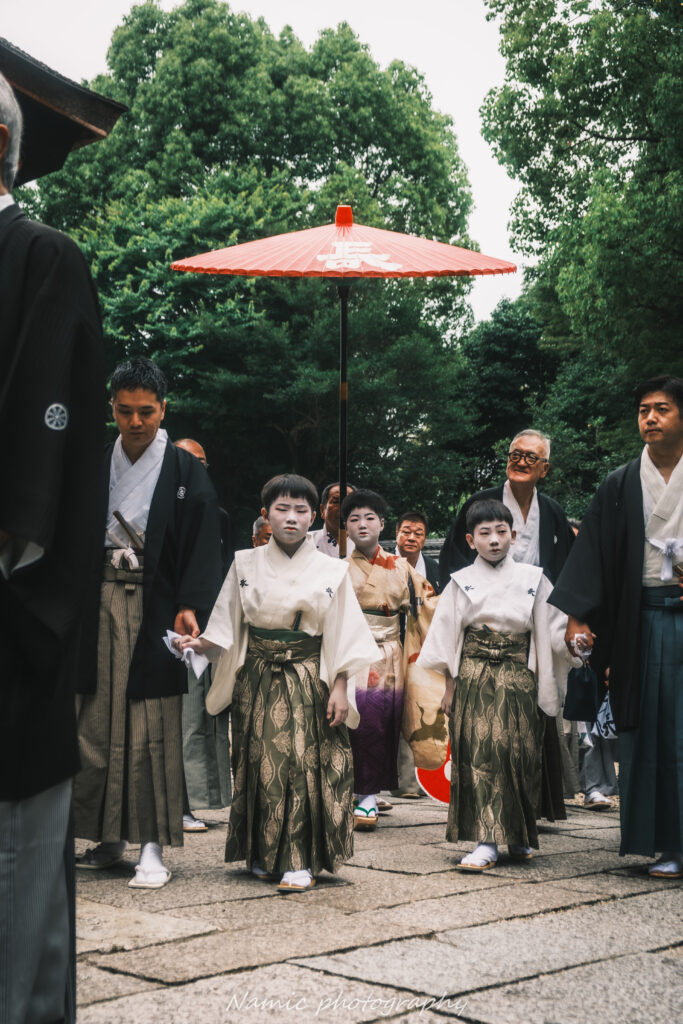
Yes — it takes place within the grounds of Yasaka Shrine, and anyone can watch. The ceremony begins at 10 a.m. The chigo and two kamuro, accompanied by their parents and relatives along with officials of the neighborhood association, enter through the shrine’s south tower gate and proceed to the main hall, the honden.
A few details of the procession are fixed by custom rather than left to individual choice. The chigo may not be led by the bare hand — whoever guides him, typically an adult relative or an official, holds his hand through a piece of white cloth rather than skin to skin. A large red ceremonial umbrella is held over him as he walks.
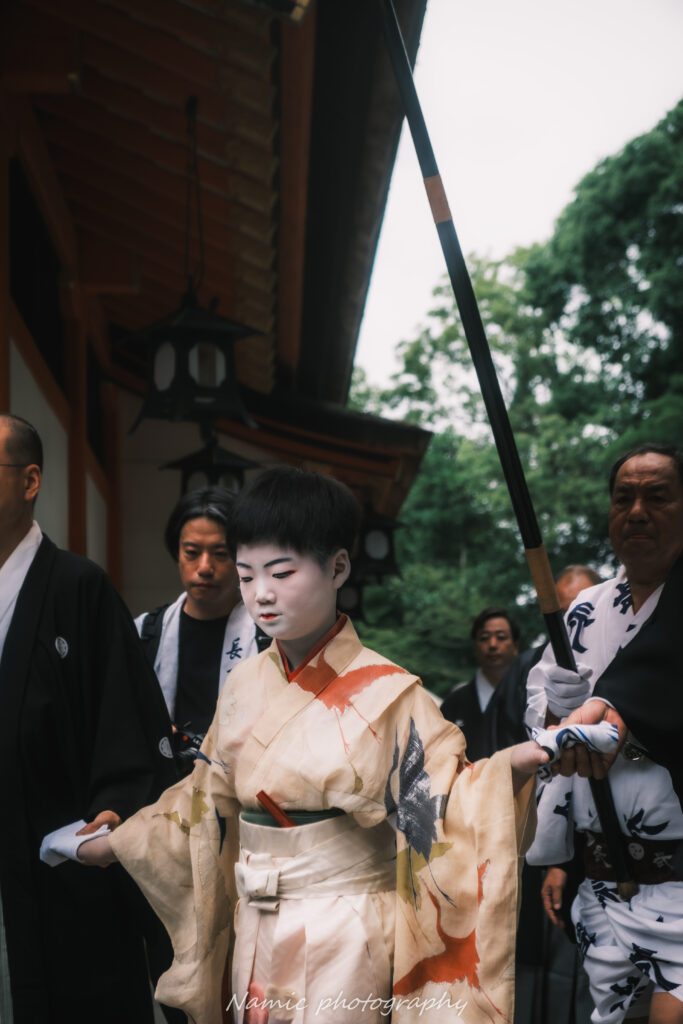
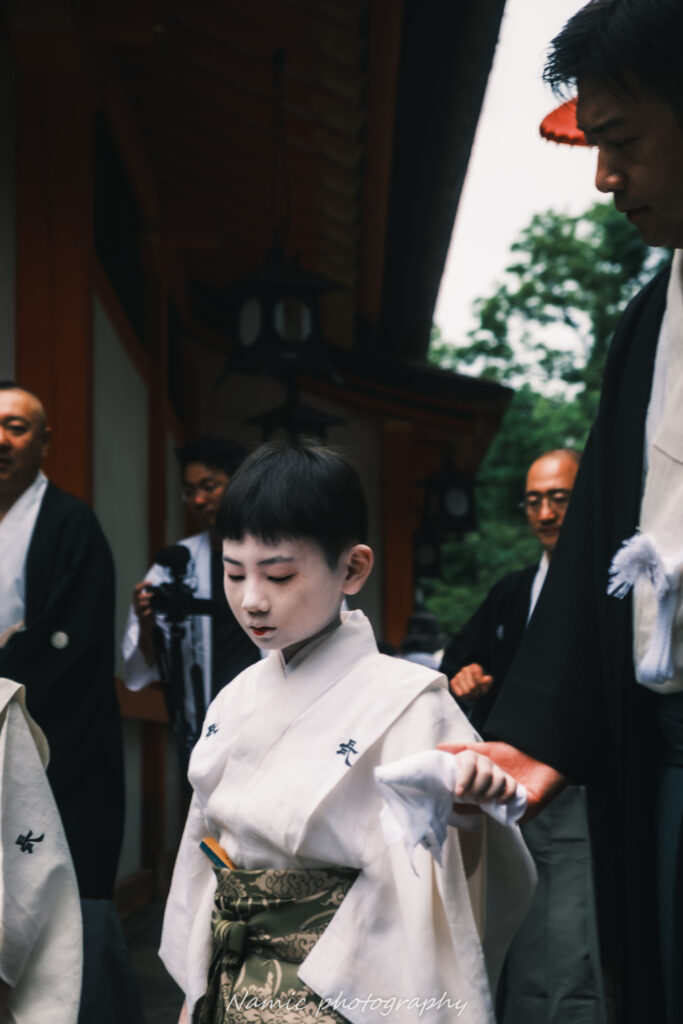
At the honden, a Shinto priest performs a purification rite and reads a formal prayer (norito) reporting the chigo’s and kamuro’s appointment to the deity and requesting a safe festival. The group then circles the main hall three times, moving clockwise. Along the way, they stop to pray twice per circuit: once at the front of the honden, and once at a smaller worship point at the rear of the building, known as the hokuhairaijo (北拝礼所), the north worship area. Three circuits at two prayer points each come to six formal prayers in total — and it is this combination of laps and participants, not the walking alone, that is counted toward the symbolic one thousand.
The rite performed inside the honden itself isn’t visible to onlookers, but the three circuits around the building are. Just follow the shrine staff’s guidance so you don’t get in the way of the chigo’s group. One thing worth knowing: you can end up standing closer to the chigo and kamuro than you’d expect — that proximity is part of what makes this ceremony worth seeing.
Why This Ceremony Is Easy to Miss
Gion Matsuri’s visual peak — the illuminated evenings before the parade (yoiyama) and the procession itself — falls between July 14 and July 17. Almost every guidebook and itinerary points visitors toward those dates. July 1 gets no comparable attention, partly because there is genuinely less to see, and partly because many people simply don’t realize the festival begins on July 1 at all.
Closing
Osendo no Gi is a Shinto rite that anyone can watch, free of charge. Its fixed form — three circuits, six prayers — is what allows it to function as a sendo-mairi, a thousand-visit prayer for the safety of the festival to come.
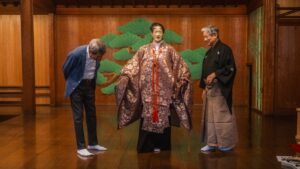
Every detail of the ceremony carries a reason behind it. The white cloth separating hand from hand isn’t a formality — it exists because touching the chigo, who is treated as a sacred presence, bare-skinned is thought to bring on ritual impurity (kegare, 穢れ). Each gesture has a purpose behind it, and nothing gets skipped. That same sensibility runs through noh and tea ceremony as well: the meaning isn’t in performing the correct form for its own sake, but in never cutting corners on the reasoning behind it.
I’ve spent close to twenty years photographing shrines, temples, and rituals like this one around Kyoto. Today, as BASE KYOTO, I run fully private cultural experiences — noh, kyogen, tea ceremony, wagashi making, zazen — each guided by working noh performers and instructors. If you’d like to understand what sits behind the traditional arts woven through Gion Matsuri by experiencing them firsthand, feel free to get in touch.