
I run a Japanese cultural experience service in Kyoto, primarily for international visitors. Kyogen — Japan’s classical comic theater — has long been on my radar as a must-add to our lineup. So when I finally attended a live performance, I went ready to take notes. What I didn’t expect was to spend the whole time laughing, leaning forward, and thinking: why doesn’t everyone know about this? This is my report — and the story of why we’re now offering Kyogen as one of our signature experiences.
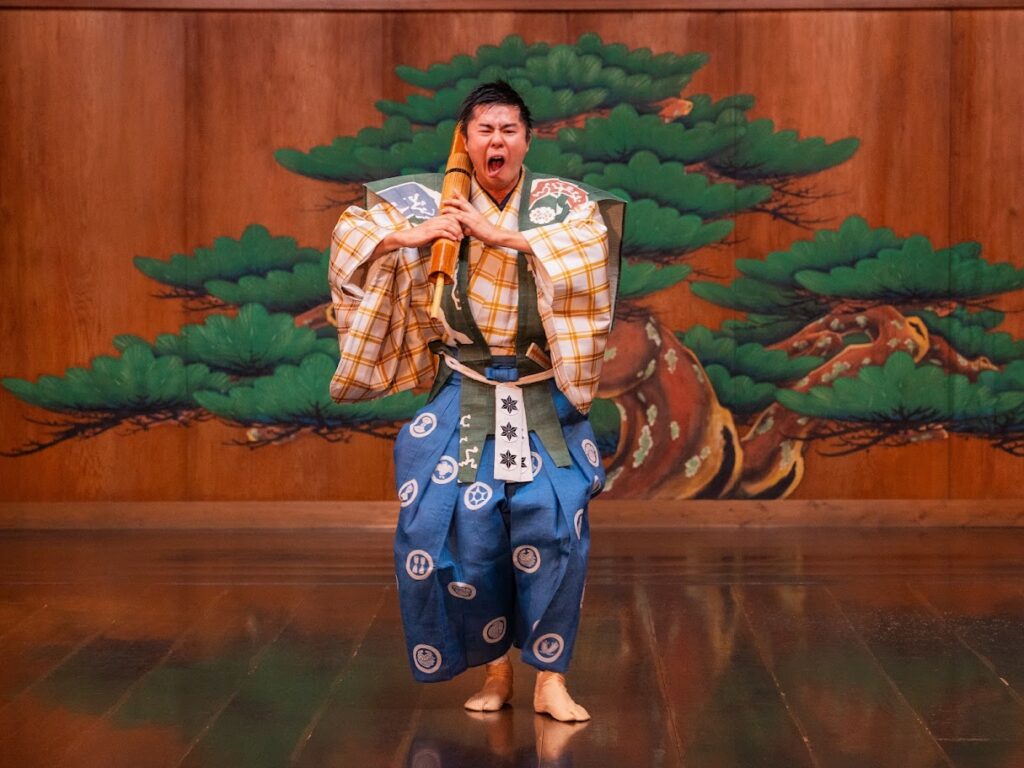
First Time at a Kyogen Performance — Oe Nohgakudo, Kyoto
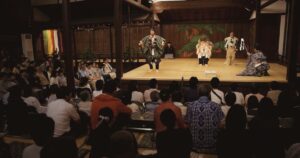
The venue was Oe Nohgakudo, a historic noh theater tucked into central Kyoto’s Nakagyo ward. Built in 1908, it holds the distinction of being Kyoto’s oldest surviving nohgakudo — and the moment you step inside, you feel it. Tatami floor seating divided by wooden frames, natural light filtering through old timber, and a silence that seems to belong to another century. Before a single performer takes the stage, the space itself is already doing something to you.
The company performing was Soshokai (草咲会), a group of young Kyogen actors. The intimacy of the venue meant we were close — close enough to read every flicker of expression on the performers’ faces. That proximity turned out to matter more than I realized.
- Japan’s oldest comic theater, originating in the Muromachi period (14th century)
- Performed on the same stage as Noh — comedy and tragedy as equals
- Actors perform with their own face (no mask), making expressions easy to read
- Minimal props: a single fan does the work of an entire set
- Listed as a UNESCO Intangible Cultural Heritage
I Expected Old-School Comedy. I Got So Much More.
My mental image of Kyogen going in: something like a medieval stand-up routine, probably hard to follow, probably a bit slow. What I got was a full range — sharp physical comedy, razor-timing dialogue, moments of genuine stillness, and passages of elegant dance that brought an entirely different kind of beauty to the stage.
What is Komai? — Kyogen’s Dance Sequences
Kyogen is classified as a comic dialogue play, but dance is also central to the art form. The short dances performed within a Kyogen program — called komai (小舞) — are performed to chanted verse and carry a formal elegance quite distinct from the comic scenes. At the Soshokai performance, several komai were performed, and the contrast they created — laughter followed by hush, energy followed by stillness — gave the evening a genuinely theatrical arc.
No Props. No Sets. And You Won’t Miss Them.
Here is one of Kyogen’s most striking features: the stage is almost completely bare. There are no sets, no elaborate props, no microphones. A single fan becomes a wine cup, a writing brush, a key. The sound of a heavy door closing is made — quite seriously — by the performer’s own voice, in a stylized onomatopoeia that somehow works perfectly.
This means the audience participates. You fill in the gaps. You build the scene in your imagination from the raw material the performer gives you. It’s theater stripped to its absolute essence — and paradoxically, that creates a more vivid experience than any elaborate set design could.
A Note on Masks in Kyogen
Kyogen is performed without masks as a general rule — actors perform with their own faces exposed. This is a key difference from Noh, where the lead role almost always wears a mask. In Kyogen, you read the performer’s actual expressions, which makes following the action far more intuitive. That said, Kyogen does have its own tradition of masks, used for roles such as demons, deities, animals, and spirits — and these tend to be far more playful and expressive in character than the austere Noh masks most people are familiar with.
For international visitors in particular, this accessibility is significant. The language of Kyogen is classical Japanese — but the large gestures, expressive faces, and physical storytelling carry the meaning across the language barrier. You may not catch every word. You will understand what’s happening.
The people on that stage were laughing at the same things we laugh at today — vanity, miscommunication, trying to get away with something. Six hundred years, and not a thing has changed.
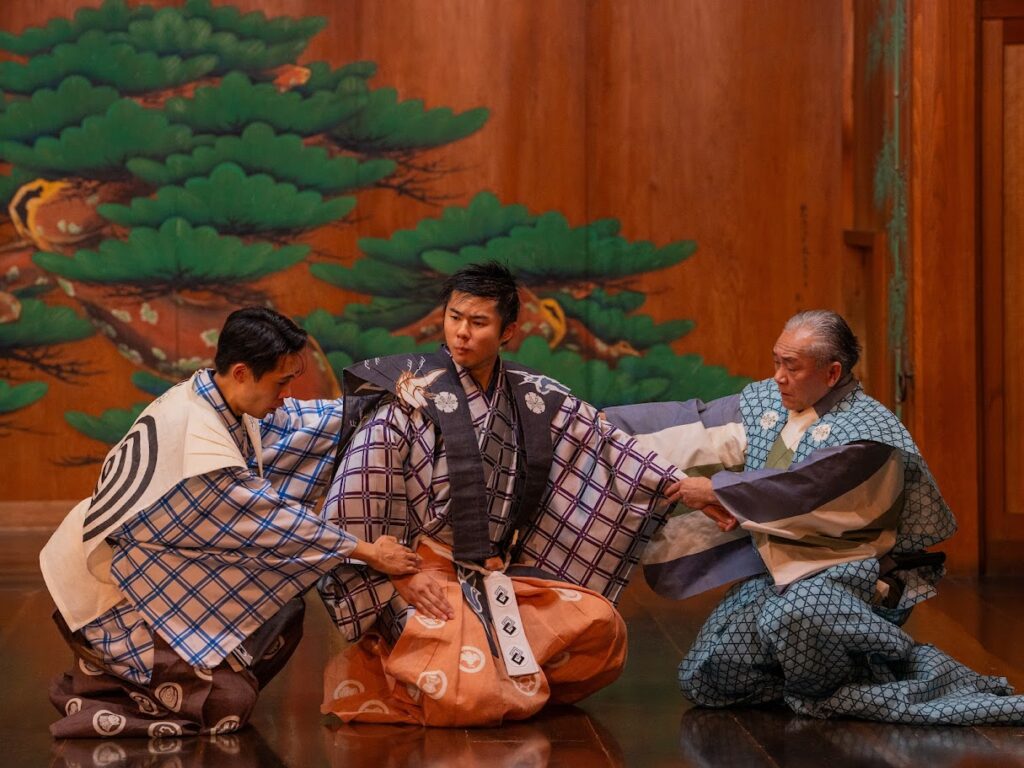
650 Years of the Same Jokes — Because They’re True
The plots of Kyogen center on recognizable human failings: a servant who can’t follow simple instructions, a husband caught in an obvious lie, someone trying to bluff their way through a situation they have no business being in. The themes are timeless — and that’s the point.
Kyogen emerged in the Muromachi period (14th century) as a comedy of everyday life, performed alongside the more solemn Noh. While Noh dealt in gods, ghosts, and tragic beauty, Kyogen concerned itself with ordinary people making ordinary mistakes. That combination of the sublime and the ridiculous, performed back-to-back on the same ancient stage, tells you something deep about how the Japanese have always understood the world.
The primary recurring characters — the master and the servant Taro Kaja — are essentially a comedy duo who have been getting into the same arguments for six centuries. The servant is cunning, often well-intentioned, regularly disastrous. The master is imperious and easily outwitted. The dynamic maps, almost uncomfortably well, onto plenty of contemporary workplaces.
The Costumes: Visually Striking in Ways You Don’t Expect
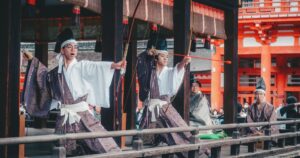
Kyogen costumes are bold. Not delicate. The short jacket (kataginu) worn by Taro Kaja characters is typically printed with oversized, graphic motifs — gourds, crabs, demons, geometric patterns — in vivid color combinations. Paired with hakama trousers, the overall look is something between formal court dress and pop art. Against the dark timber of a centuries-old nohgakudo, the effect is visually arresting.
For anyone curating visual content about Japan — photographers, social media producers, or simply visitors with a camera — a Kyogen performance is far more photogenic than most expect.
The Space Is Part of the Experience
Watching Kyogen at Oe Nohgakudo is not the same experience as watching it in a modern theater with padded seats. Seated on tatami, surrounded by aged wood, looking at a stage backed by a hand-painted pine — this is immersive in a way that’s difficult to replicate. The building itself has been here since the Meiji era. It has held thousands of performances. That accumulation is palpable.
For international visitors seeking an authentic encounter with Japanese traditional arts — not a tourist-optimized version of one — this kind of setting is exactly what they’re looking for.
Why Kyogen Belongs in Your Program — For Any Audience
Kyogen is listed as a UNESCO Intangible Cultural Heritage. It is, objectively, one of the world’s great theatrical traditions. And yet even most Japanese people have never seen it. This is something I find both surprising and — from a business perspective — genuinely exciting, because it means the experience still carries the full weight of discovery for almost every first-time viewer.
For International Visitors
Kyogen offers something increasingly rare in Japanese tourism: a cultural experience that doesn’t require fluency, doesn’t feel like a museum, and isn’t staged for tourist consumption. It’s a real art form, performed by dedicated artists, in a historic space — and it’s funny. That combination is hard to find anywhere in the world, let alone in one place.
For Corporate Groups & Incentive Travel
Beyond the entertainment value, Kyogen offers three specific learning angles that resonate strongly in professional development contexts:
The Art of Communication Without Crutches
Kyogen performers convey entire scenes using nothing but their voice and body. No slides, no props, no visual aids. Watching an expert do this is an immediate, visceral lesson in what communication actually is — and a useful provocation for anyone who relies too heavily on supporting materials when presenting.
The Power of Ma — Strategic Silence
Japanese aesthetics has a concept called ma (間) — the meaningful pause, the space between things. In Kyogen, silence is used deliberately to build tension, signal a shift, or let a joke land. For business professionals who tend to fill every pause in a meeting or negotiation, experiencing ma in practice is a surprisingly useful recalibration.
Hierarchy, Wit, and the Limits of Authority
The master-servant dynamic in Kyogen is endlessly revealing. The servant always thinks he’s smarter (and is often right). The master has the power but loses every battle of wits. Six hundred years of audiences have laughed at this — because it’s true. As a starting point for conversations about organizational dynamics, leadership, and psychological safety, it’s disarming in exactly the right way.
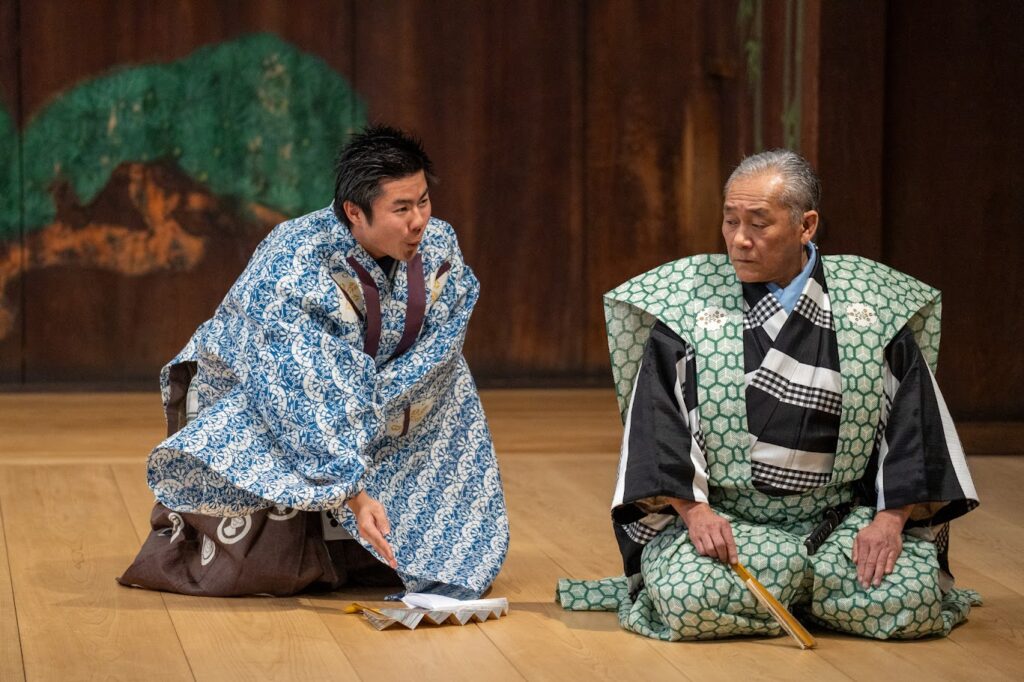
Kyogen Experiences — Now Available
We’re offering Kyogen as part of our Japanese cultural experience lineup in Kyoto. Whether you’re an independent traveler, a tour operator, or a corporate event planner, we’ll tailor a program to fit your needs.
Kyogen Performance + Guided Experience
Attend a live Kyogen performance with an English-language briefing beforehand and a Q&A session with the performers afterward. Ideal for individuals and small groups seeking an authentic encounter.
Kyogen Workshop — Venue of Your Choice
A hands-on workshop led by a Kyogen practitioner, covering the art’s techniques and philosophy, with a participatory element. Suitable for incentive travel, leadership programs, and team-building events. We come to you.
Who This Is For
International Visitors :Travelers seeking authentic Japanese culture beyond temples and shrines — something alive, surprising, and genuinely fun.
Tour Operators & DMCs:A differentiated cultural add-on that requires no specialist venue — easy to program, impossible to forget.
Incentive & Corporate Planners: A Japan-only experience that offers genuine professional development framing — communication, leadership, cultural intelligence.
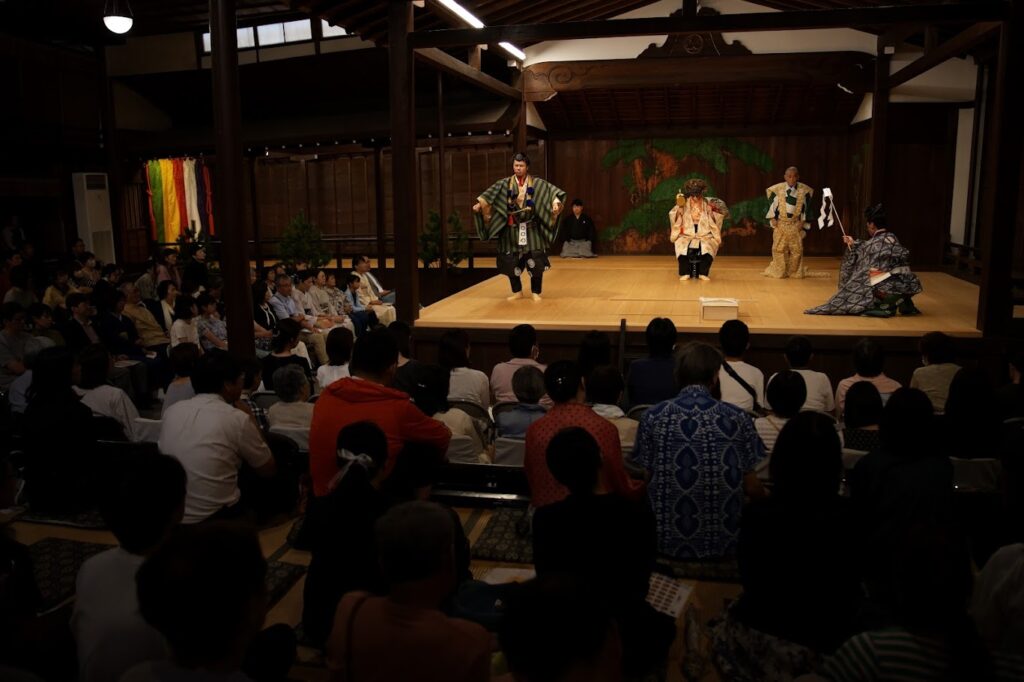
Just Go See It — And Know That We Can Bring It To You
If you’ve never seen Kyogen, I’ll say this simply: go. The barrier you’re imagining — the language, the formality, the fear of not understanding — is not what you’ll find. What you’ll find is a room full of people laughing together at something human and timeless. First-timers consistently describe it as one of the best surprises of their trip to Japan.
And here’s what makes Kyogen particularly flexible as an experience: it needs no stage. Because Kyogen was built around the performer’s body and voice alone, it travels. A Kyogen performance or workshop can happen in a hotel ballroom, a conference room, a garden, or a rooftop. Wherever your group is, Kyogen can come to them. If you’re planning a tour program, a corporate offsite, or any event where you want to offer something genuinely extraordinary — please get in touch.